Report of Marriage for Filipinos Abroad: Guide to Getting Your PSA Marriage Certificate
Report of Marriage for Filipinos Abroad is a legal process that allows Filipino citizens who were married outside the Philippines to register their marriage with the nearest Philippine Embassy or Consulate. Once the report is processed and transmitted to the Philippine Statistics Authority (PSA), couples can request an official PSA Marriage Certificate for visa applications, passport updates, surname changes, immigration, inheritance, and other legal transactions.
This complete guide explains the eligibility requirements, required documents, filing procedures, processing timelines, fees, common mistakes to avoid, and how to obtain your PSA Marriage Certificate after your foreign marriage has been successfully registered.
Quick Answer Box
What is a Report of Marriage? It’s the official document Filipino citizens must file with a Philippine Embassy or Consulate after marrying abroad, so the marriage can be registered with the Philippine Statistics Authority (PSA) and reflected in the civil registry.
Who needs to file it? Any Filipino citizen (whether married to another Filipino or to a foreign national) whose wedding took place outside the Philippines.
Where do you file it? At the Philippine Embassy or Consulate that has jurisdiction over the country where the marriage happened.
How long does it take? Typically 3 to 6 months from submission to PSA availability, though this varies by post and workload.
What do you get in the end? A PSA-issued marriage certificate (also called an SR — Security Paper — copy), which is the legally recognized proof of marriage in the Philippines.
What Is a Report of Marriage (and Why It Matters)
A Report of Marriage is a legal document that formally notifies the Philippine government that one of its citizens has married abroad. Once processed, this report becomes the basis for the PSA to issue an official marriage certificate — the same type of document you’d get if the wedding took place in the Philippines.
Here’s the part many people don’t realize: marrying abroad doesn’t automatically show up in Philippine civil registry records. Your foreign marriage certificate (from the U.S., UK, Japan, UAE, or wherever the wedding happened) is valid in that country, but it means nothing to Philippine government agencies until it’s reported through the ROM process.
Without a PSA marriage certificate, you may run into problems with:
- Applying for spousal visas or immigration petitions
- Changing your surname on your Philippine passport
- Claiming spousal benefits (SSS, GSIS, PhilHealth, Pag-IBIG)
- Settling inheritance or property matters
- Enrolling dependents in government or embassy records
In my experience helping families navigate PSA-related documentation, this is one of the most overlooked steps for overseas Filipino workers (OFWs) and immigrants — couples assume the foreign marriage certificate is “enough,” only to discover years later, often during a visa interview or estate matter, that it was never registered in the Philippines.
Who Needs to File a Report of Marriage
You need to file a ROM if:
- You are a Filipino citizen who got married in a foreign country, regardless of your spouse’s nationality.
- Both parties are Filipino citizens who married abroad (e.g., a destination wedding).
- One party is Filipino and the other is a foreign national, and the marriage was solemnized overseas.
You do not need to file a ROM if:
- The marriage took place in the Philippines (this is handled directly by the local civil registrar where the wedding occurred).
- Neither party is a Filipino citizen (though PSA registration wouldn’t apply in this case anyway).
Important nuance: Even if only one spouse is Filipino, the ROM must still be filed. The foreign spouse’s documents are still required as part of the submission.
Required Documents Checklist
Bring complete, original documents — most embassies won’t process incomplete submissions, and delays here are the single biggest cause of processing setbacks.
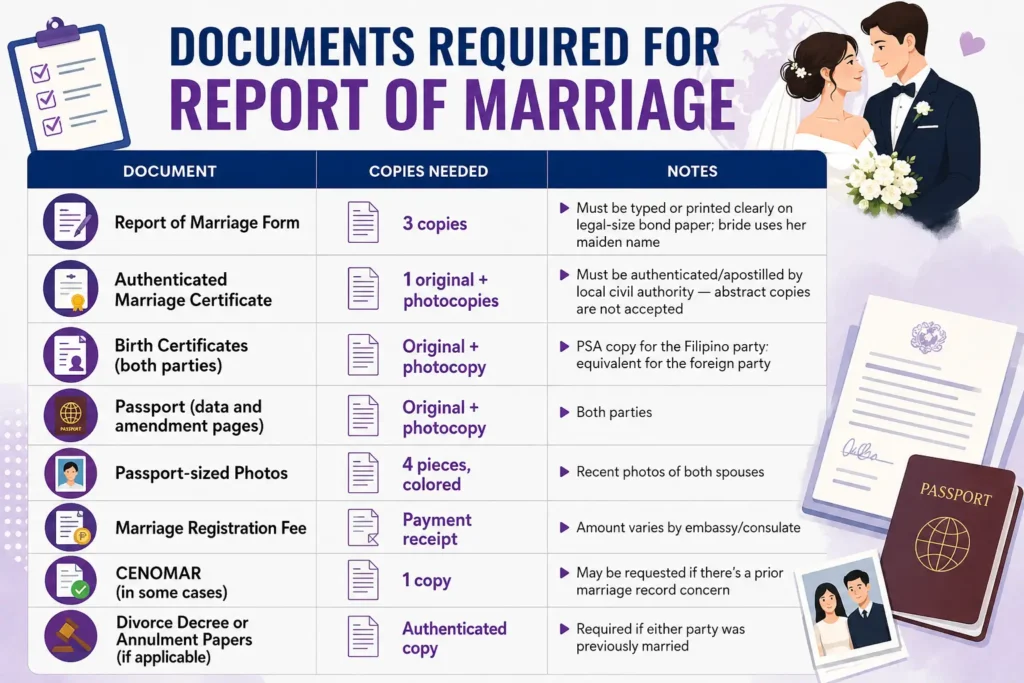
Pro tip: Always call or check the specific embassy or consulate’s website before your appointment. Requirements can differ slightly — some posts request notarized affidavits, others may ask for additional proof of the foreign spouse’s civil status.
Process to Register Your Marriage Abroad
Step 1: Secure an Authenticated Copy of Your Foreign Marriage Certificate
Before anything else, get the marriage certificate authenticated (or apostilled, depending on the country) by the relevant local government office. An abstract or uncertified copy will be rejected outright.
Step 2: Download and Complete the Report of Marriage Form
The form is available through the DFA or the specific embassy/consulate website. Print three copies on legal-size bond paper. Fill it out carefully — the bride’s maiden name must be used, and all entries should match your official documents exactly.
Step 3: Gather All Supporting Documents
Compile birth certificates, passport copies, photos, and (if applicable) prior divorce or annulment records. Double-check that names, dates, and places match across every document.
Step 4: Set an Appointment With the Philippine Embassy or Consulate
Most posts now require online appointment booking through the consular section’s website. Walk-ins are rarely accepted, especially post-pandemic.
Step 5: Submit Documents and Pay the Fees
Present all originals and photocopies during your appointment. Pay the required registration fee (this varies by country and currency). Keep your official receipt.
Step 6: Wait for Transmission to the DFA and PSA
The embassy forwards your Report of Marriage to the DFA in Manila, which then transmits it to the PSA’s Office of the Civil Registrar General for registration.
Step 7: Monitor and Confirm PSA Availability
After roughly 3 to 6 months, check with the PSA (via their online verification system or helpline) to confirm your marriage certificate is now on file and ready for release.
Step 8: Order Your PSA Marriage Certificate
Once available, request your official PSA copy — either online or at a PSA outlet — for use in legal, immigration, or government transactions.
Report of Marriage vs. Local Marriage Registration: Key Differences
| Aspect | Marriage in the Philippines | Marriage Abroad (Report of Marriage) |
|---|---|---|
| Who registers it | Officiating solemnizing officer / local civil registrar | The couple, at the Philippine Embassy/Consulate |
| Filing location | Local Civil Registry Office (LCRO) | Philippine Foreign Service Post abroad |
| Processing time | Usually a few weeks to 2 months | 3–6 months on average |
| Document required | Certificate of Marriage from LCRO | Authenticated foreign marriage certificate + ROM form |
| Final output | PSA Marriage Certificate | PSA Marriage Certificate (via ROM) |
| Common delays | Rare, unless data errors exist | Authentication issues, incomplete forms, high embassy workload |
Processing Time and Fees
Processing time depends heavily on the embassy’s workload and the volume of documents being transmitted to Manila. As a general rule:
- Embassy processing: A few weeks to compile and forward your documents
- DFA to PSA transmission: Adds another 1–2 months
- PSA registration and encoding: Can take up to 3–6 months total from submission
Fees vary by country since embassies charge in local currency, and amounts are periodically adjusted. Always confirm current fees directly with the embassy or consulate handling your case, since online estimates can go stale quickly.
Common Mistakes That Delay Registration
- Submitting an abstract instead of an authenticated marriage certificate. This is the #1 rejection reason.
- Name inconsistencies across documents. Even minor spelling differences between your passport, birth certificate, and marriage certificate can trigger delays or requests for affidavits.
- Incomplete ROM forms. Missing fields or illegible handwriting often bounce the application back.
- Not disclosing a prior marriage. If either spouse was previously married, failing to submit the annulment or divorce decree can stall or void the registration.
- Assuming the foreign marriage certificate alone is sufficient. It isn’t — the ROM is a separate legal step.
How to Check Your ROM Status
- Contact the embassy or consulate directly where you filed — they can confirm if your documents were transmitted to the DFA.
- Use the PSA’s online verification tools to check if your marriage record has been encoded into the civil registry database.
- Follow up periodically, roughly every 4–6 weeks, rather than waiting passively for months. Consular staff often move faster on files that are actively tracked by the applicant.
What to Do After You Get Your PSA Marriage Certificate
Once your PSA marriage certificate is confirmed available, you can:
- Request an SR (Security Paper) copy online or at a PSA outlet
- Use it to update your civil status on your Philippine passport
- Submit it for spousal visa petitions or immigration processes
- Present it to claim spousal benefits under SSS, GSIS, PhilHealth, or Pag-IBIG
- Use it for property, inheritance, or other legal transactions requiring proof of marriage
If you haven’t ordered your copy yet, our complete guide on ordering a PSA marriage certificate online or via walk-in covers payment options, delivery timelines, and answers to common ordering questions.
FAQs About Report of Marriage for Filipinos Abroad
1. What happens if I don’t report my marriage abroad?
Your marriage remains unrecognized in Philippine civil registry records. This can block visa applications, name changes, and benefit claims that require proof of marital status.
2. Can I file the Report of Marriage even years after the wedding?
Yes. There’s no strict deadline, though filing sooner avoids complications, especially if you need the certificate for time-sensitive matters like visa petitions.
3. Do I need to be present in person to file a Report of Marriage?
Generally yes, at least one spouse (usually the Filipino citizen) needs to appear at the embassy or consulate for submission, though policies vary by post.
4. Is the Report of Marriage the same as a marriage license?
No. A marriage license is required before the wedding; the Report of Marriage is filed after a marriage that occurred abroad, to register it with Philippine authorities.
5. What if my marriage certificate is not in English?
You’ll need a certified translation along with the authenticated original, since embassies typically require documents in English or Filipino.
6. Can I still file if I already divorced my foreign spouse?
Yes, the marriage still needs to be registered to establish the legal record, and the divorce would be addressed as a separate recognition process under Philippine law.
7. How much does the Report of Marriage cost?
Fees vary by embassy and are charged in local currency. Check directly with your specific Philippine Embassy or Consulate for current rates.
8. What if there’s an error on my PSA marriage certificate after registration?
You can file a petition for correction of entry through the PSA or the LCRO handling your record, similar to correcting errors on a birth certificate.
9. Can same-sex marriages performed abroad be registered through ROM?
Philippine law currently does not recognize same-sex marriage, so such unions typically cannot be registered through the Report of Marriage process.
10. Where can I download the Report of Marriage form?
It’s available through the Department of Foreign Affairs website or directly from the specific embassy/consulate’s consular section page.
Conclusion
Getting married abroad is exciting, but the paperwork afterward is what protects your legal rights back home. The Report of Marriage process exists so your union is recognized not just where the wedding happened, but in the Philippines too.
Key takeaways:
- File your Report of Marriage at the Philippine Embassy or Consulate with jurisdiction over where you married.
- Make sure your marriage certificate is authenticated, not just an abstract copy.
- Expect the full process, from submission to PSA availability, to take around 3–6 months.
- Double-check names and details across all documents to avoid delays.
- Once available, order your PSA marriage certificate promptly for future legal and immigration needs.
Handle this step early, and you’ll avoid the scramble that comes when a visa office, benefits agency, or legal matter suddenly asks for a document you don’t have yet.