How to Report a Late Registration of Birth: Complete Step-by-Step Guide 2026
How to Report a Late Registration of Birth is an important process for individuals whose birth was not registered within the legally required period. Whether you need a birth certificate for school enrollment, passport applications, employment, marriage, or government services, completing a late birth registration ensures your birth record is officially recognized. In this 2026 guide,
you’ll learn the eligibility requirements, required documents, step-by-step application process, filing fees, processing time, and practical tips to avoid delays or rejection. By following this guide, you can complete your late registration smoothly and obtain your official birth certificate with confidence.
Quick Answer Box
What is late registration of birth? It’s the process of registering a birth with the Local Civil Registry more than 30 days after the child was born.
Where do you file it? At the LCR office of the city or municipality where the birth occurred.
What do you need?
- 4 copies of the Certificate of Live Birth
- Affidavit of Delayed Registration (notarized)
- Supporting documents (baptismal certificate, school records, immunization card, etc.)
- Marriage certificate of parents, if applicable
How long does it take? Typically 2–4 weeks, factoring in the mandatory 10-day public posting period.
What’s the result? A PSA-registered birth certificate marked “Delayed Registration,” which is fully valid for passports, school enrollment, employment, and other legal transactions.
What Is Late Registration of Birth?
Late registration – also called delayed registration – happens when a birth is reported to the Local Civil Registry more than 30 days after the actual date of birth.
Under normal circumstances, birth registration is handled quickly. Hospital staff usually process the Certificate of Live Birth for hospital deliveries. Midwives typically do the same for home births or births at birthing clinics. In many cases, parents themselves file the paperwork.
But life gets busy. A newborn brings sleepless nights, medical appointments, and a hundred small emergencies. It’s genuinely common for the 30-day deadline to slip by unnoticed — sometimes by weeks, sometimes by decades.
I’ve seen cases where adults in their 40s and 50s discover, only when applying for a passport or retirement benefits, that their birth was never formally registered. The good news: the process to fix this exists precisely for these situations, and it works.
Once the 30-day window closes, the LCR treats the filing as a delayed registration. This requires extra documentation — primarily a sworn affidavit explaining the delay — but it does not make the eventual birth certificate any less legally valid.
Why Timely Registration Matters
A birth certificate isn’t just paperwork. It’s the foundational identity document that unlocks nearly every other transaction in a person’s life.
Without a registered birth certificate, a person cannot:
- Apply for a Philippine passport
- Enroll in school (from kindergarten through university)
- Get a National ID, SSS, GSIS, or PhilHealth number
- Open a bank account requiring government ID
- Claim insurance benefits or inheritance
- Get legally married
- Apply for most jobs, especially in government or with formal employers
This is exactly why late registration exists — not as a punishment, but as a correction mechanism. The system recognizes that delays happen, and it provides a clear legal path to make things right.
Legal Basis for Birth Registration in the Philippines
Civil registration in the Philippines is governed primarily by Act No. 3753 (the Civil Registry Law), along with implementing rules issued by the Philippine Statistics Authority (PSA), formerly the National Statistics Office (NSO).
The PSA sets the standard 30-day filing period and defines the documentary requirements for registrations filed beyond that window. Local Civil Registrars, who operate under city and municipal governments, are the frontline offices responsible for receiving, evaluating, and approving these applications before the record is transmitted to the PSA for national archiving.
Understanding this structure matters because it explains why you file locally (at the LCR) but the certified copy you eventually receive comes from the PSA — the national repository of all civil registry documents.
Requirements for Late Registration of Birth
Requirements differ slightly depending on whether the person whose birth is being registered is a minor or already an adult.
If the Person Is a Minor (Under 18)
| Requirement | Details |
|---|---|
| Certificate of Live Birth | 4 copies, fully accomplished and signed by both parents (or the informant) |
| Affidavit of Delayed Registration | Found at the back of the Certificate of Live Birth; accomplished by the father, mother, or legal guardian |
| Supporting information in the affidavit | Child’s name, date and place of birth, father’s name (for illegitimate children if acknowledged), parents’ marriage details (if married), and the specific reason for the delay |
| Additional supporting documents (as required by LCR) | Baptismal certificate, immunization record, school records, or a notarized certification from a hospital or attending midwife |
If the Person Is 18 Years Old or Older
| Requirement | Details |
|---|---|
| All minor requirements above | Still apply |
| Certificate of Marriage | Required if the applicant is already married |
| Valid government-issued ID | Often requested by LCR staff for identity verification |
| Two disinterested persons’ affidavits | Some LCR offices require sworn statements from people who can attest to the applicant’s identity and birth details, especially for registrations filed decades late |
Practical tip: Requirements can vary slightly by city or municipality. Before preparing documents, call or visit the specific LCR office where the birth occurred to confirm their current checklist. This single phone call can save you an extra trip.
What Is an Affidavit of Delayed Registration of Birth?
An Affidavit of Delayed Registration of Birth is a notarized sworn statement explaining why a birth wasn’t registered within the standard 30-day period.
This isn’t just a formality — it’s the document that gives the LCR legal grounds to accept a registration outside the normal timeframe. Without it, the application cannot proceed.
The affidavit typically includes:
- Full name and details of the child (or the adult applicant, if registering their own delayed birth)
- Exact date and place of birth
- Names of the parents
- Parents’ marriage details, if applicable
- A clear, honest explanation for the delay — common reasons include lack of awareness of the deadline, financial constraints, remote location of the LCR, or family emergencies
- Signature of the affiant, notarized by a lawyer or authorized notary public
Common, acceptable reasons for delay include ignorance of the requirement, being based abroad at the time, financial hardship, or the family residing in a remote area far from the LCR office. Registrars have seen every version of this explanation — honesty and clarity work far better than a vague or inconsistent account.
Where to File a Late Registration of Birth
You must file the delayed registration at the Local Civil Registry (LCR) office of the city or municipality where the birth occurred — not where you currently live, and not any LCR office of convenience.
This is a frequent point of confusion. For example, if a child was born in Cebu City but the family now resides in Quezon City, the late registration must still be filed in Cebu City, since that’s the place of birth.
If you’re a Filipino citizen who was born abroad, delayed registration follows a different route — through the Philippine Foreign Service Post (embassy or consulate) that has jurisdiction over the place of birth, or through the Department of Foreign Affairs upon return to the Philippines.
Process of Late Birth Registration
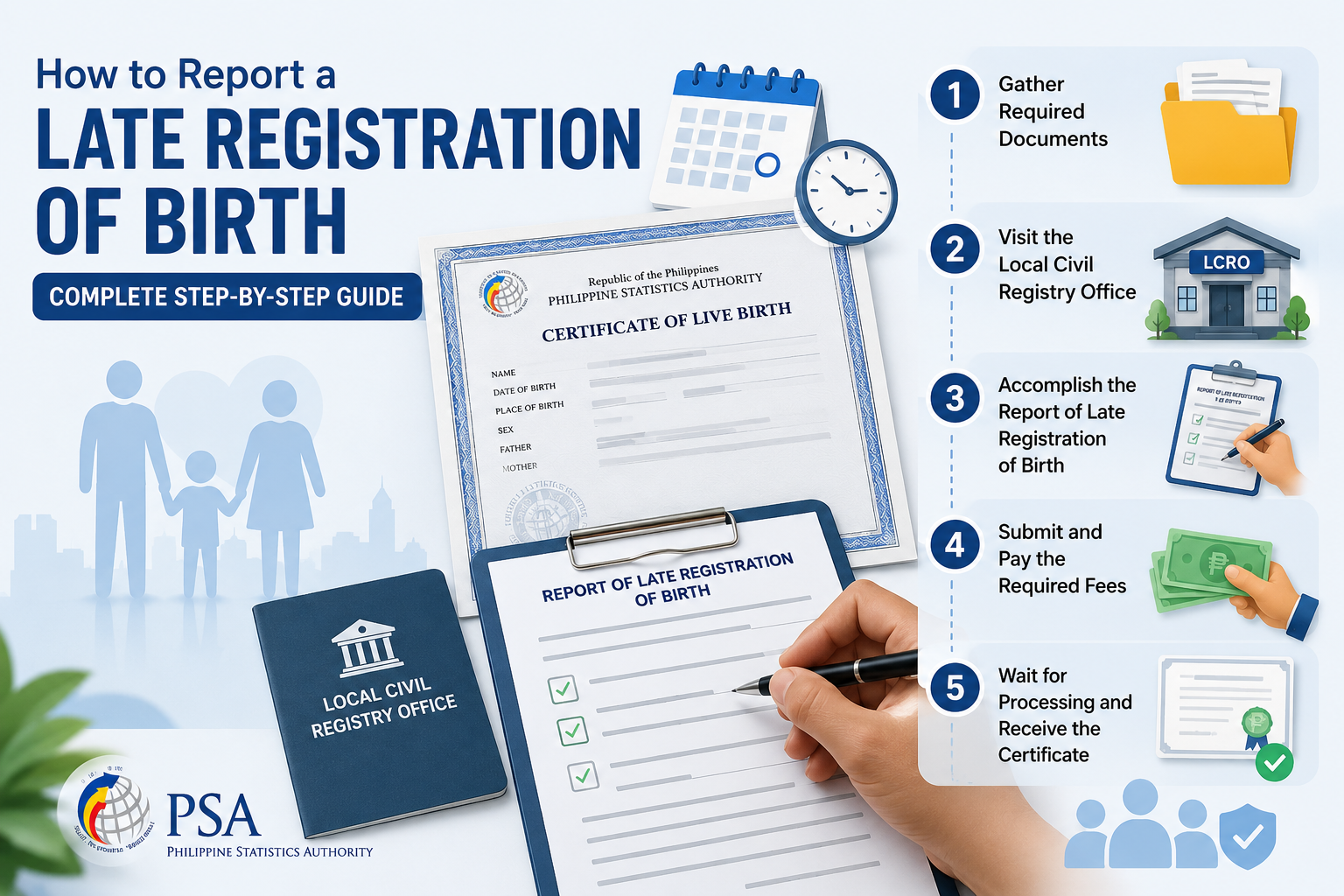
Here’s exactly what happens from submission to approval Step-by-Step:
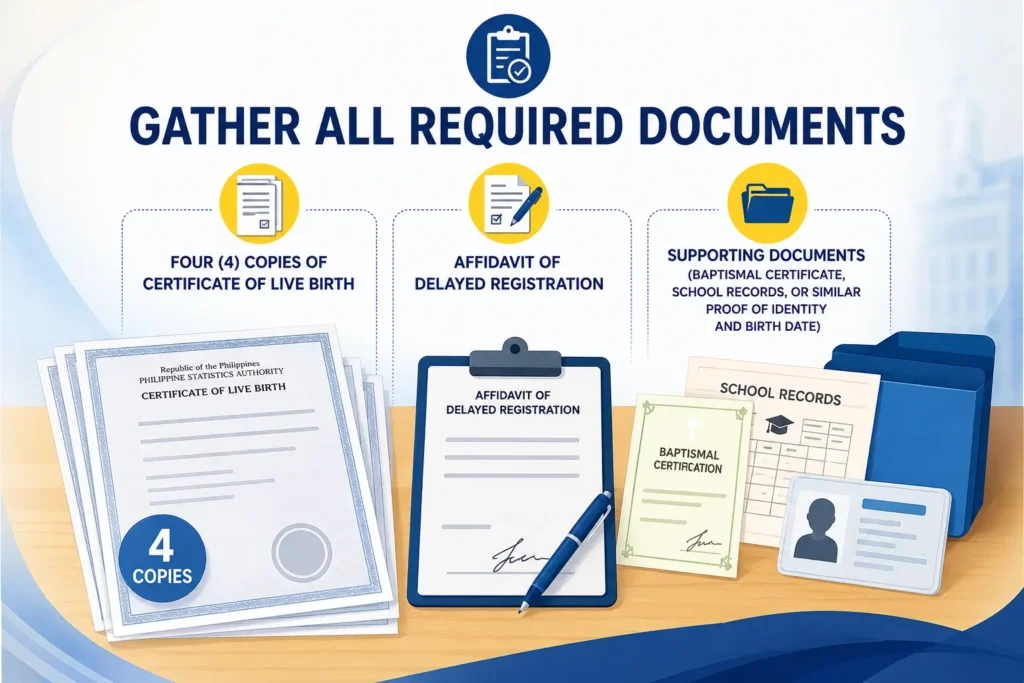
Step 1: Gather All Required Documents
Prepare four copies of the Certificate of Live Birth, complete the Affidavit of Delayed Registration, and collect supporting documents (baptismal certificate, school records, or similar proof of identity and birth date).
Step 2: Submit to the LCR Office
File the complete set of documents at the LCR office covering the place of birth. The civil registrar examines the Certificate of Live Birth and all submitted documentary requirements for completeness and consistency.

Step 3: Posting of the Pending Application
The application is posted publicly on the bulletin board of the city or municipal hall where the birth occurred. This serves as public notice, giving anyone with a valid objection the chance to come forward.
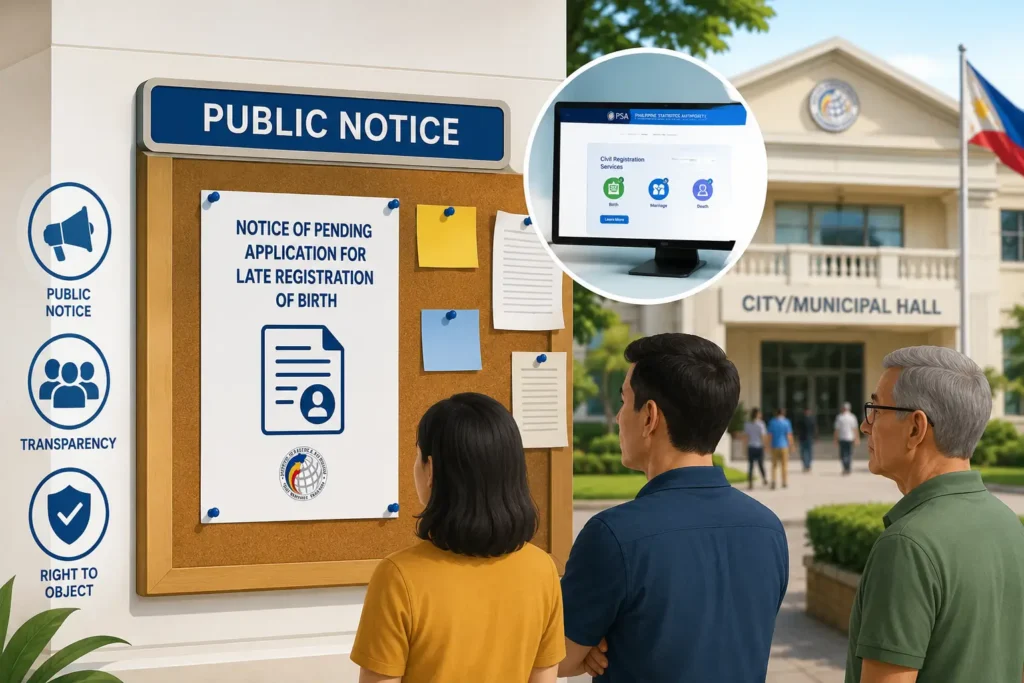
Step 4: 10-Day Waiting Period
The notice remains posted for 10 days. If no objection or adverse claim is filed during this period, the LCR proceeds to the next stage.

Step 5: Evaluation and Verification
After the posting period lapses without objection, the registrar evaluates and verifies all submitted documents for accuracy.

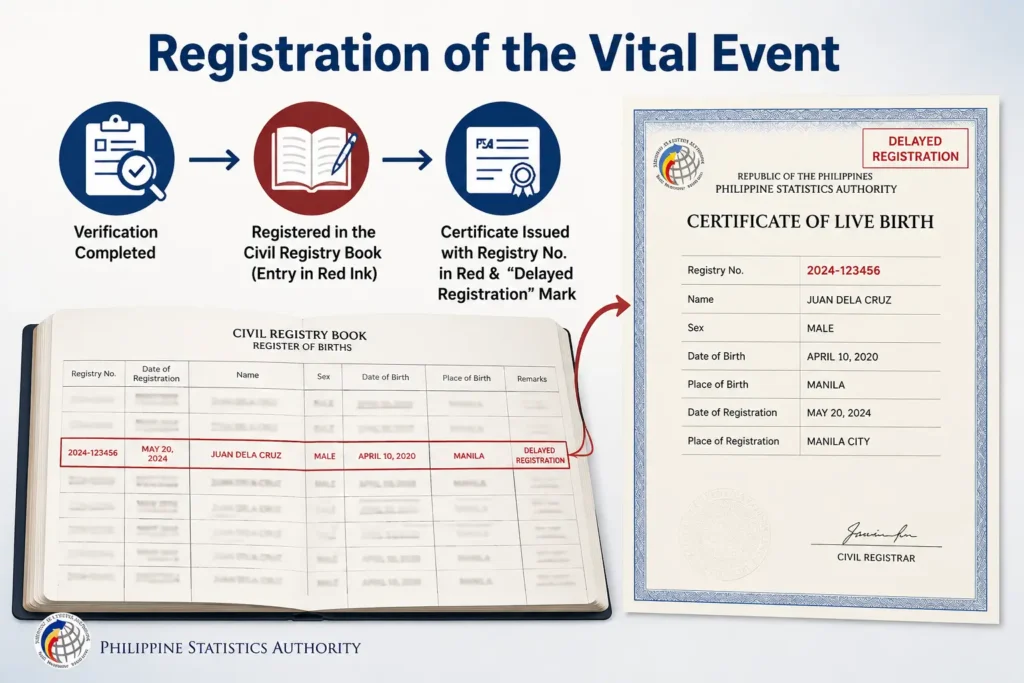
Step 6: Registration of the Vital Event
Once verification is complete, the LCR formally registers the birth. Because it’s a delayed registration, the entry is marked in red ink in the civil registry book, and the registry number on the certificate is also printed in red. The words “Delayed Registration” appear on the upper right-hand margin of the certificate.
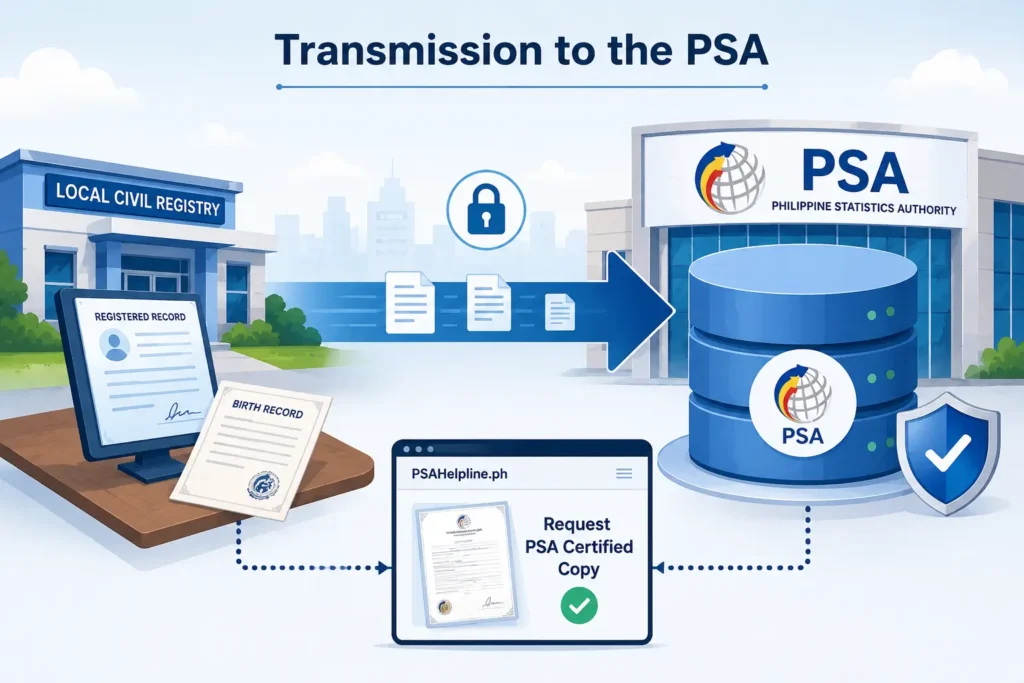
Step 7: Transmission to the PSA
The LCR forwards the registered record to the PSA, where it becomes part of the national civil registry database. This is what eventually allows you to request an official PSA-certified copy.
Expert insight: Applicants often assume the process ends the moment they submit documents. In reality, the 10-day posting requirement is mandatory and cannot be waived or expedited, so factor that into your timeline if you need the certificate for something time-sensitive like passport renewal or school enrollment.
Timely vs. Late Registration: Key Differences
| Aspect | Timely Registration | Late (Delayed) Registration |
|---|---|---|
| Filing deadline | Within 30 days of birth | Anytime after the 30-day window |
| Required affidavit | Not required | Affidavit of Delayed Registration required |
| Public posting | Not required | Mandatory 10-day posting period |
| Certificate appearance | Standard black ink entry | Marked in red ink with “Delayed Registration” notation |
| Processing time | Faster, usually within days | Longer, typically 2–4 weeks due to posting and verification |
| Supporting documents | Minimal | Additional proof of identity/birth may be required |
| Legal validity | Fully valid | Equally fully valid once approved |
The critical takeaway from this comparison: a delayed registration carries the same legal weight as a timely one. The red-ink notation simply documents the process it went through — it does not diminish the document’s authenticity or usability.
Common Mistakes That Delay Approval
Based on patterns seen across LCR offices nationwide, these mistakes cause the most rejections or resubmissions:
- Inconsistent details across the Certificate of Live Birth, affidavit, and supporting documents (misspelled names, mismatched birth dates)
- Filing at the wrong LCR — remember, it’s always the place of birth, not current residence
- Incomplete affidavit missing the required explanation for the delay
- Unnotarized affidavit — the affidavit must be sworn before a notary public to be valid
- Missing supporting documents when the LCR requires additional proof (common for registrations filed decades late)
- Dealing with fixers instead of official LCR staff, which can lead to overcharging or fraudulent processing
Trustworthy tip: Always confirm you’re transacting with legitimate LCR or city hall personnel. Fees and requirements should only ever be discussed with authorized staff — never with unofficial “fixers” who approach applicants outside government offices.
Fees Involved
Fees for late registration vary by city or municipality, since LCR offices set their own schedule of fees within guidelines set by local ordinances. Expect additional charges compared to timely registration, covering:
- Filing and processing fees
- Notarization of the affidavit
- Certified true copy fees (if requesting extra copies at the LCR)
Because amounts differ across locations, it’s best to call the specific LCR office beforehand to confirm current rates. This avoids surprises and lets you prepare the exact amount needed.
After Registration: Getting Your PSA Birth Certificate
Once your delayed registration is approved and transmitted to the PSA, you’ll eventually be able to request an official PSA-certified copy — the document actually required for passports, school enrollment, employment, and other transactions.
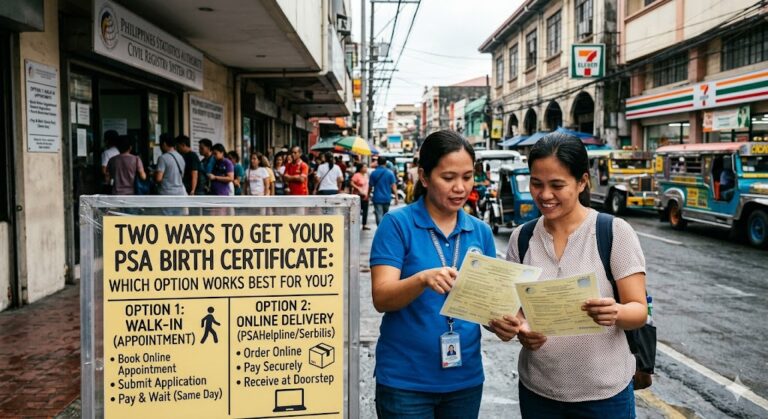
You don’t need to visit a PSA office in person or book an online appointment slot to get this. Services like PSAHelpline.ph let you request your PSA birth certificate online and choose how you receive it:
- Home delivery to your doorstep
- Pickup at participating National Book Store or Robinsons Department Store branches near you
This flexibility is especially useful for people who registered late precisely because visiting government offices was difficult in the first place — whether due to distance, work schedules, or mobility constraints.
Keep in mind that newly registered records, especially delayed ones, sometimes take a bit longer to appear in the PSA database compared to timely registrations. If your request comes back with a “not yet available” status shortly after LCR approval, it usually just means the record hasn’t finished transmitting to the PSA’s central database yet.
FAQs About How to Report a Late Registration of Birth
How long does late registration of birth take in the Philippines?
Typically 2 to 4 weeks, largely because of the mandatory 10-day public posting requirement plus document evaluation time at the LCR.
Can I register a birth that happened 20 or 30 years ago?
Yes. There’s no expiration on the right to register a birth. Older delayed registrations may simply require more supporting documents, such as school records, baptismal certificates, or affidavits from disinterested persons, since original birth attendants may no longer be available to confirm details.
Is a delayed birth certificate less valid than a regular one?
No. Once registered and approved by the PSA, a delayed birth certificate carries the same full legal validity as one registered on time. The only visible difference is the red-ink “Delayed Registration” notation.
What if my birth was never registered anywhere?
You’ll need to go through the delayed registration process at the LCR covering your actual place of birth, providing whatever supporting evidence you have (baptismal certificate, school records, medical records, or affidavits from witnesses present at your birth).
Do I need a lawyer to notarize the Affidavit of Delayed Registration?
The affidavit must be notarized by a notary public, who is typically a lawyer commissioned to notarize documents. You don’t need to hire a lawyer beyond this notarization step for a straightforward late registration.
What happens during the 10-day posting period?
Your pending application is publicly posted at the city or municipal hall where the birth occurred, giving the public an opportunity to raise any objection or adverse claim before the LCR finalizes the registration.
Can I file late registration if I currently live abroad?
Yes. If you were born in the Philippines but currently reside abroad, you can authorize a representative through a Special Power of Attorney to file on your behalf at the appropriate LCR, or coordinate with the Philippine embassy or consulate for guidance.
Where do I get a copy of my PSA birth certificate after late registration is approved?
Once the record has been transmitted to and processed by the PSA, you can request a certified copy through PSAHelpline.ph, choosing either home delivery or pickup at a participating National Book Store or Robinsons Department Store branch.
Conclusion
Reporting a late registration of birth might feel intimidating, but it’s a well-defined, manageable process. Here’s what to remember:
- Late registration applies once you’re past the 30-day window from the date of birth
- File at the LCR covering the actual place of birth — not your current residence
- Prepare the Certificate of Live Birth, a notarized Affidavit of Delayed Registration, and any required supporting documents
- Expect a mandatory 10-day public posting period before final approval
- A delayed birth certificate is just as legally valid as a timely one — it’s simply marked differently for record-keeping
- Once registered and transmitted to the PSA, you can conveniently request your certified copy through PSAHelpline.ph
Getting this document sorted, even years later, opens the door to passports, school enrollment, employment, and countless other transactions that depend on proof of identity. It’s worth doing right, and it’s worth doing now.