Negative Certification: What It Truly Means To Get It Hassle-Free 2026
Most people run into the term “Negative Certification” at the worst possible time – right in the middle of a job application, an immigration filing, or a legal process – and have no clear idea what it actually means. The good news is it is not as complicated as it sounds.
This guide breaks down exactly what Negative Certification is, why it gets issued, who needs it, and how to get it – step by step, without the confusion.
What is Negative Certification?
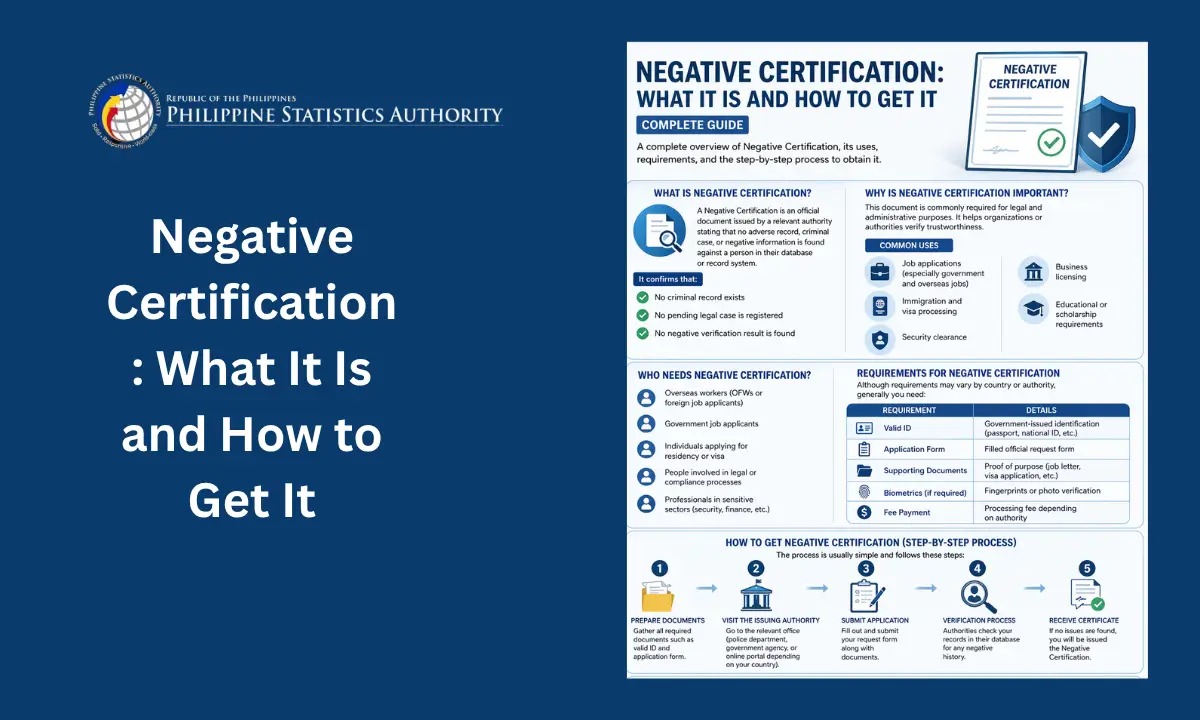
A Negative Certification is an official document issued by a relevant authority – such as the Philippine Statistics Authority PSA – after searching their database or record system and finding no criminal case, no adverse record, and no negative verification result against the person requesting it.
In the context of PSA, this means the central database was checked across both its digital system and paper records for a civil event – a birth, marriage, or death – and returned no match.
What it confirms:
- No criminal record is on file
- No pending legal case has been registered
- No negative verification result was found
- It serves as proof of clean background status
Important: A negative result does not mean the record is lost or destroyed. It usually means the record exists at the local level but was never forwarded to PSA.
Why is Negative Certification Important?
This document is used across legal and administrative purposes where organizations and authorities need to verify trustworthiness before proceeding.
Common situations where it is required:
- Job applications, especially government roles and overseas jobs
- Immigration and visa processing
- Security clearance evaluations
- Business licensing requirements
- Educational and scholarship applications
Who Needs Negative Certification?
Not everyone will need this document, but certain groups encounter it regularly:
- Overseas workers (OFWs) and foreign job applicants
- Government job applicants going through background checks
- Individuals applying for residency or visa in another country
- People involved in legal or compliance processes
- Professionals in sensitive sectors such as security and finance
Why PSA Shows a Negative Result
There are three main reasons a negative result comes back, and knowing which one applies to your situation helps you respond correctly:
| Reason | What It Means |
|---|---|
| Endorsement not yet sent | Record exists at LCRO but was never forwarded to PSA |
| Request made too early | New records take 2–6 months to appear in PSA’s system after endorsement |
| Problem during transfer | Record was filed locally but got delayed, misplaced, or incorrectly submitted |
None of these are permanent situations. All of them have a clear resolution path.
Requirements for Negative Certification
Requirements may vary by country or authority, but the standard documents needed are:
| Requirement | Details |
|---|---|
| Valid ID | Government-issued identification such as passport or national ID |
| Application Form | Completed official request form |
| Supporting Documents | Proof of purpose such as a job letter or visa application |
| Biometrics (if required) | Fingerprints or photo verification |
| Fee Payment | Processing fee set by the issuing authority |
How to Get Negative Certification
Prepare Your Documents Gather your valid ID, completed application form, and any supporting documents tied to your proof of purpose.
Visit the Issuing Authority Go to the relevant office a police department, government agency, or online portal depending on your country. For PSA cases, this means visiting the LCRO of the city or town where the birth, marriage, or death was registered.
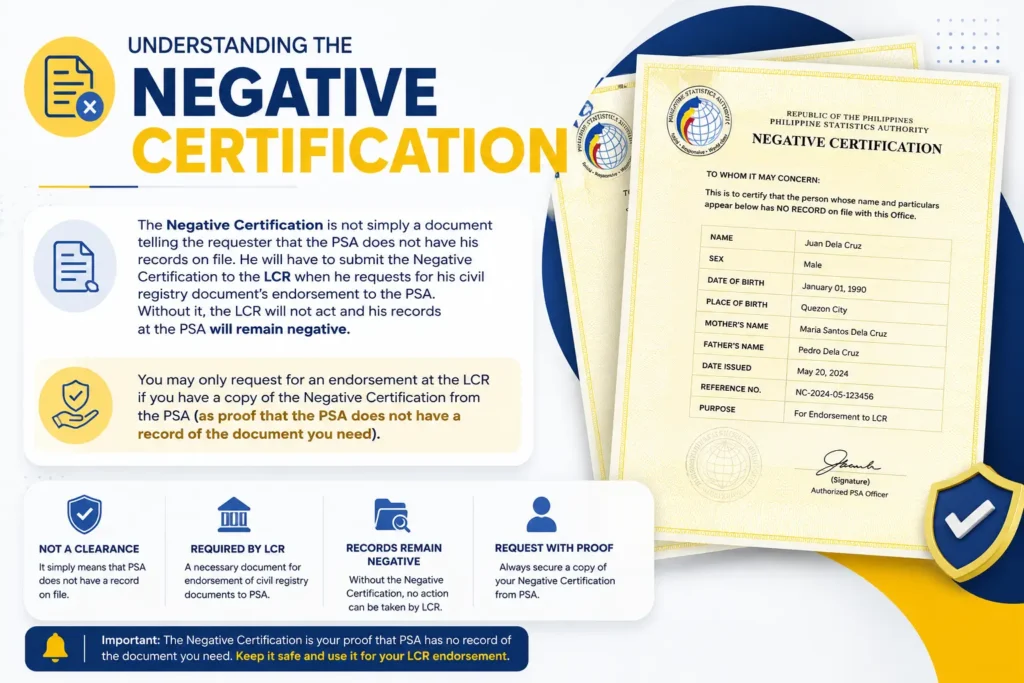
Submit Your Application Hand over your request form and documents. If you are at the LCRO, inform staff that PSA issued a Negative Certification, show your original copy, and ask them to search local records and provide a certified copy as proof.
Verification Process Authorities check records in their database for any negative history. If following up after a negative result, request these documents from the LCRO:
- Personal certified copy of the record
- Copy of the endorsement or transmittal letter addressed to PSA
- Courier receipt or proof of delivery if a courier was used
Late Registration (If Record Is Truly Missing) If the LCRO also cannot locate the record, the event was likely never registered. In this case:
- File a late registration for the birth, marriage, or death at the LCRO
- Once approved, the LCRO creates and sends the record to PSA for national filing
- Only after this step can PSA issue a certificate
Follow Up with PSA Central Office Bring the following documents to PSA East Avenue (Metro Manila) or your nearest PSA CRS office:
- Original Negative Certification from PSA
- Certified copy from the LCRO
- Endorsement or transmittal letter
- Forwarder or courier receipt (if available)
How Records Move from LCRO to PSA
Civil registration in the Philippines follows two clear steps:
Local Registration at LCRO When a birth, marriage, or death occurs, the certificate is filed at the Local Civil Registry Office of the city or town where the event took place. The LCRO checks the details and keeps the original record in its local files.
Endorsement to PSA The LCRO must then send a copy of the record to PSA for national filing and digitization. PSA can only issue certificates that appear in its own database. If the record never arrived, PSA issues a Negative Certification.
Waiting periods before requesting a PSA copy:
- Metro Manila registrations: wait 2 to 4 months
- Provincial registrations: wait up to 6 months
About the Fee You Paid
The payment made whether online or over the counter – cannot be refunded. The fee covers the official search PSA conducted on your behalf. Since the search was completed and a result was returned, the process is considered fulfilled regardless of the outcome.
This applies whether the request was submitted through PSAHelpline.ph or at a physical PSA outlet.
Getting Your Official PSA Certificate
Once the LCRO has endorsed the record and PSA has digitized it:
- Wait for confirmation from PSA or the LCRO that the record is fully updated
- Order a new copy online through PSA’s official channels
- The certificate received will be the officially recognized version, valid for all legal and personal transactions and printed on PSA Security Paper (SECPA)
Processing Time
| Type | Estimated Time |
|---|---|
| Standard Processing | 1–5 working days |
| Fast Track (if available) | Same day or 24 hours |
| Manual Verification | Up to 7–10 days |
Processing time depends on location and system load. Manual verification cases take longer, especially when records need to be traced back through LCRO files.
Key Points to Remember
- A Negative Certification is not a criminal punishment document
- It only confirms the absence of negative records in official systems
- Requirements differ by country and agency
- Always apply through official sources to avoid fraud
- Do not discard the Negative Certification – it is a primary requirement for endorsement
FAQs About Negative Certification
What does a Negative Certification mean?
It means the PSA searched its national database and could not find the record you requested. The record may still exist at the local civil registry but was either not properly sent to PSA or the request was made too early in the processing period.
What is the difference between a Negative Certification and a regular PSA certificate?
A regular PSA certificate confirms that a record was found and is being issued officially. A Negative Certification confirms the opposite – that no record was found in PSA’s archives for that specific civil event.
Is a Negative Certification the same as saying I have no birth, marriage, or death record?
No. It only means PSA does not have it in their system. The record usually exists at the Local Civil Registry Office level and simply was not yet endorsed or forwarded to PSA.
Can I get a refund if PSA issues me a Negative Certification instead of the document I requested?
No. The fee covers the official search PSA conducted. Since the search was completed and a result was returned, a refund is not applicable – whether the request was made online through PSAHelpline.ph or at a PSA outlet.
What should I do after receiving a Negative Certification from PSA?
Visit the LCRO of the city or town where the event was registered. Ask them to confirm if the record exists locally, request a certified copy, and ask for the endorsement or transmittal letter. If the record is missing at the local level too, file a late registration.
What is a certificate of no record of marriage in the Philippines?
This is a PSA document stating that no marriage record exists in their system for a specific person. It is commonly used as proof that someone is legally single, and it is often required for civil registry processes and personal legal transactions.
How do I check my PSA birth certificate status?
You can check online through PSA’s official website or by contacting your local PSA office. They will confirm whether your record is available or whether a Negative Certification was issued for your request.
How long does it take to resolve a Negative Certification issue?
It depends on the reason. If the record simply was not forwarded yet, the timeline depends on LCRO and PSA processing speeds, which can take weeks to months. If late registration is needed, the process takes longer since a new record must be created, approved, and endorsed before PSA can issue the certificate.
Conclusion
A Negative Certification is not the end of the road – it is a signal that tells you exactly where to look next. Whether it came back because of a missing endorsement, an early request, or an unregistered life event, the resolution path is clear and manageable.
Start at the LCRO, confirm the record, gather your endorsement documents, and follow up with PSA. Once the record is properly filed and digitized, you can request the official certificate online and use it confidently for any legal or personal purpose. The process takes patience, but it is entirely solvable