Family Preparedness: The Vital Role of PSA Birth Certificates in Your Child’s Milestones 2026
Every parent knows the feeling: a school suddenly asks for a document “by tomorrow,” and you’re digging through drawers, folders, and old bags trying to find it. More often than not, that document is your child’s PSA birth certificate.
It’s easy to think of a birth certificate as a one-time formality — something you get right after delivery and then forget about. In reality, it’s one of the most frequently requested documents throughout your child’s life, from first grade enrollment to their first passport, first driver’s permit, and even their first job application.
This guide breaks down exactly why the PSA birth certificate deserves a permanent, organized place in your family’s document system — and how to keep it ready for every milestone ahead.
Quick Answer Box
Why is a PSA birth certificate important for family preparedness?
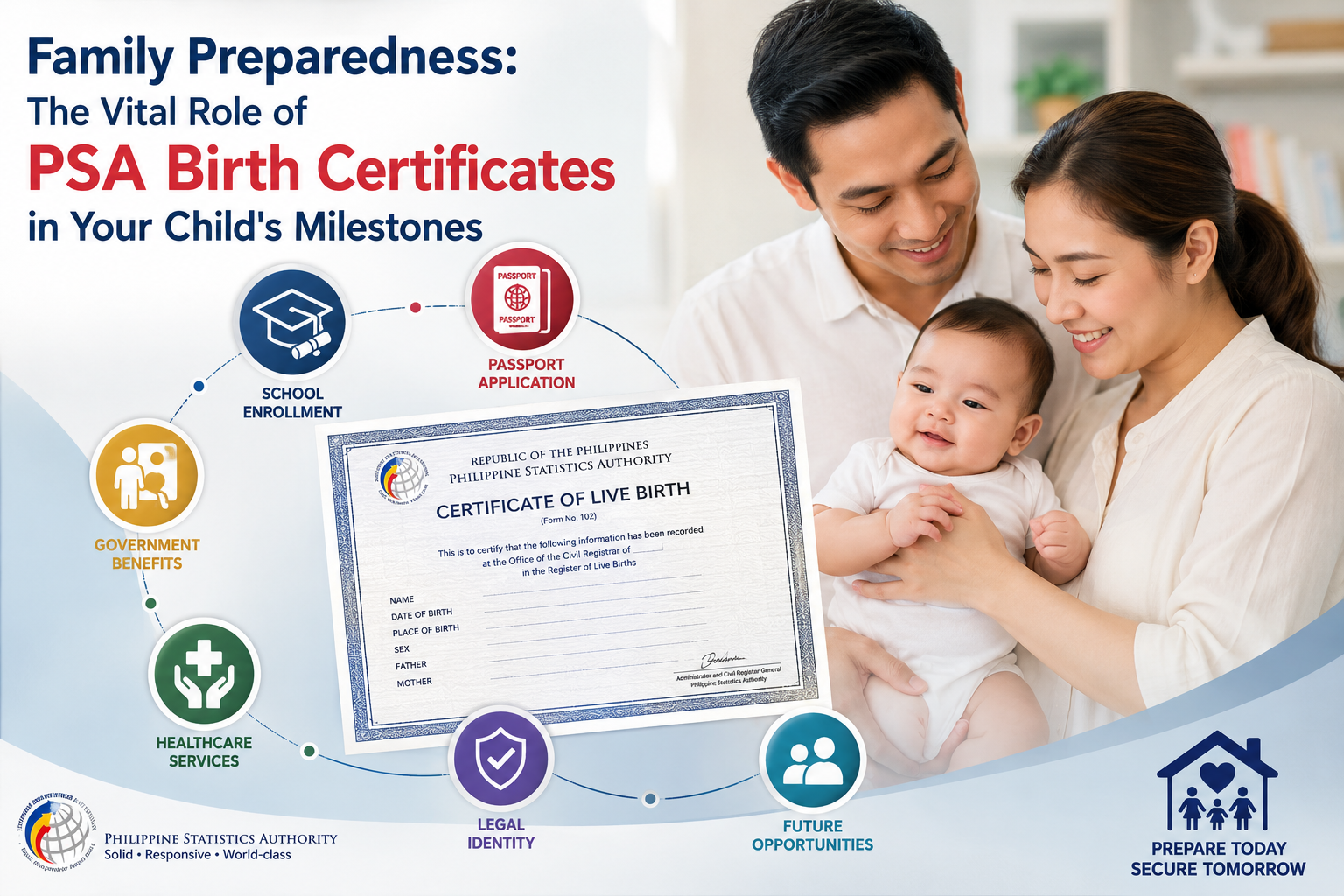
A PSA (Philippine Statistics Authority) birth certificate is the primary legal proof of identity, age, citizenship, and parentage in the Philippines. It is required for:
- School enrollment and graduation
- PhilID (Philippine National ID) registration
- Passport and visa applications
- Student driver’s permit applications at the LTO
- Scholarship, insurance, and government benefit claims
- Correcting civil registry errors (name, birthdate, gender, birthplace)
Best practice: Keep at least 3–5 PSA-certified copies per child on hand at all times, stored in a fireproof folder, with digital scans backed up in cloud storage. Order additional copies online through the PSA Serbilis or PSAHelpline.ph portals whenever your stock runs low.
What Is a PSA Birth Certificate, Exactly?
A PSA birth certificate is an official record of birth issued by the Philippine Statistics Authority, the government agency responsible for civil registration nationwide. It is different from the certified true copy issued by your Local Civil Registry Office (LCRO), though both originate from the same registered event.
The PSA copy carries a security paper (SECPA) with a dry seal, QR code, and barcode — features that make it the version accepted by nearly every government office, school, and foreign consulate.
Key details found on a PSA birth certificate:
- Full legal name of the child
- Date and place of birth
- Sex
- Names of parents and their citizenship
- Date the birth was registered
- Registry number
Because this document ties together identity, parentage, and citizenship in one record, it becomes the anchor document for almost every other ID or transaction your child will need later in life.
Why Family Preparedness Starts With Your Child’s Birth Certificate
Family preparedness isn’t only about emergency kits and evacuation plans – it also means having your household’s legal paperwork organized and accessible before it’s urgently needed.
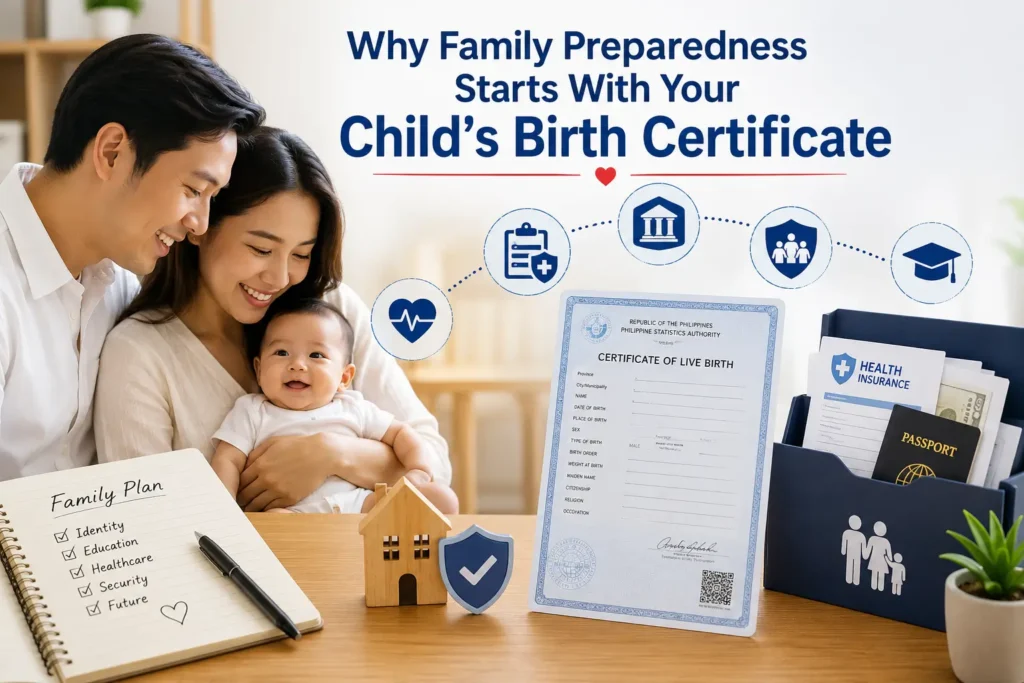
Think of the PSA birth certificate as the “root document” of your child’s identity. Nearly every other credential — school ID, national ID, passport, driver’s license — traces back to it. If that root document is missing, delayed, or full of errors, everything built on top of it stalls.
Parents who treat document readiness as part of everyday family management, not a last-minute scramble, consistently report smoother transitions during:
- School enrollment season
- Summer travel planning
- Scholarship and financial aid deadlines
- Sudden emergencies (hospitalization, relocation, custody matters)
This is the mindset shift this article encourages: your child’s birth certificate isn’t paperwork you deal with once. It’s infrastructure you maintain continuously.
Navigating Educational Transitions With Ease
Schools in the Philippines — public and private — require a PSA birth certificate at nearly every transition point:
- First-time enrollment (Kindergarten or Grade 1)
- Transferring schools mid-year or between school years
- Graduation (elementary, junior high, senior high)
- Board exam and college application requirements
Missing this document at enrollment can mean a delayed start to the school year, or in worst cases, a child being placed on a waitlist while paperwork is sorted out.
Expert tip: Enrollment periods are peak season for PSA requests, and processing times can stretch longer than usual. Order your copies at least 4–6 weeks before enrollment opens, not the week of.
Common School Documentation Bottlenecks
| Situation | Why the PSA Copy Is Needed | Risk If Delayed |
|---|---|---|
| First-time Grade 1 enrollment | Confirms legal name and age eligibility | Enrollment placed on hold |
| Transferring schools | Cross-verifies student records between institutions | Delayed transfer credentials |
| Senior high to college | Required for college admission and scholarship applications | Missed application deadlines |
| Board exam registration | Confirms identity matches academic records | Exam application rejected |
Getting a PhilID for Your Child
The Philippine Identification System (PhilSys), which issues the PhilID, is open to Filipinos of all ages — including newborns and toddlers.
How parents register a minor for PhilID:
- Prepare the child’s PSA birth certificate.
- Visit a PhilSys registration center or barangay-based registration site.
- Submit the birth certificate along with the parent’s valid ID.
- Complete demographic data capture (biographic details are recorded for young children; biometrics like fingerprints and iris scans are typically deferred).
- Receive the PhilSys Number (PSN) and PhilID card once processed.
Important milestone: Once the child turns 14 years old, a biometric update (photo, fingerprints, iris scan) is required to fully activate the ID for adult transactions. This transforms the early registration into a lifelong, continuously valid PhilID record.
Having the PSA birth certificate ready from day one prevents registration delays and ensures your child’s PhilSys record is accurate from the start.
Whether it’s your child’s very first passport or a parent applying for the first time as an adult, the Department of Foreign Affairs (DFA) requires a PSA-certified birth certificate to verify identity and Philippine citizenship.
This requirement applies to:
- First-time passport applicants (minors and adults)
- Visa applications for many countries, especially those requiring proof of relationship for minors traveling with one parent
- Name changes on passports due to marriage, annulment, or widowhood
Special case — widowhood: If a Filipina is updating her surname on her passport following the death of her spouse, the DFA requires both the PSA birth certificate and the PSA death certificate of the deceased spouse as supporting documents.
Real-world example: A family planning a summer trip abroad often discovers, only weeks before departure, that their child’s passport application needs an original PSA copy — not a photocopy, and not the hospital-issued record. Families who already keep a current PSA copy on file can submit their DFA application within days, while others may face weeks of delay waiting for a fresh copy to arrive.
Obtaining a Student Driver’s Permit
When your teenager is ready to apply for a Student Driver’s Permit (SDP) at the Land Transportation Office (LTO), a PSA birth certificate is part of the standard requirement list. It serves as the LTO’s proof of the applicant’s identity and age eligibility.
Typical LTO student permit requirements:
- PSA birth certificate (original and photocopy)
- Valid government-issued ID (if available) or PhilID
- Completed LTO application form
- Medical certificate (as required by LTO guidelines)
Because the SDP is often a teen’s first solo government transaction, having the birth certificate ready in advance avoids the anxiety of a rejected application on the actual appointment day.
Early Detection and Correction of Errors
One of the most overlooked benefits of keeping birth certificates on hand isn’t about a specific transaction — it’s about catching mistakes early.
Common errors found on birth certificates include:
- Misspelled first, middle, or last names
- Incorrect or missing birthdate
- Wrong birthplace
- Inaccurate sex/gender entry
- Missing or incorrect parent information
These errors can be corrected through:
- Administrative correction under RA 9048 and RA 10172, filed at the Local Civil Registry Office (LCRO) where the birth was registered, for clerical errors, first name changes, and sex/birthdate corrections in specific cases.
- Judicial correction, filed in court, for more substantial changes (e.g., changes involving legitimacy status or complex name discrepancies).
Why early correction matters: An error that seems minor — like a misplaced letter in a middle name — can cause mismatches later when the name doesn’t match other IDs like the PhilID, passport, or school records. Catching and fixing it while your child is young is far simpler than untangling multiple mismatched government records years later.
PSA Birth Certificate Requirements at a Glance (Comparison Table)
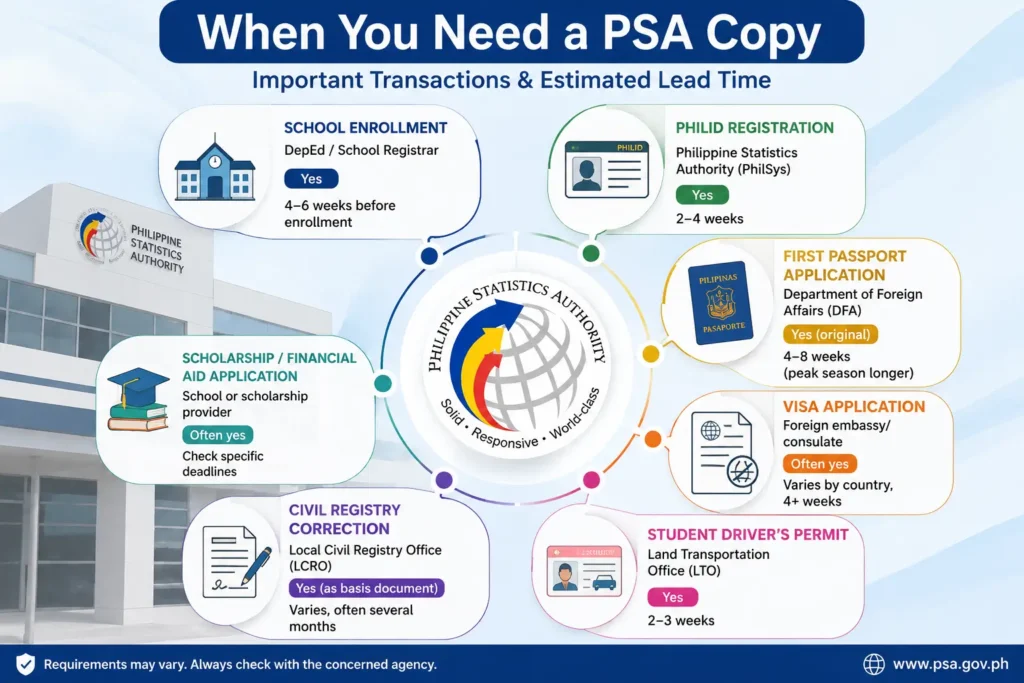
| Milestone/Transaction | Government Agency | PSA Copy Required? | Typical Lead Time to Prepare |
|---|---|---|---|
| School enrollment | Department of Education (DepEd) / school registrar | Yes | 4–6 weeks before enrollment |
| PhilID registration | Philippine Statistics Authority (PhilSys) | Yes | 2–4 weeks |
| First passport application | Department of Foreign Affairs (DFA) | Yes (original) | 4–8 weeks (peak season longer) |
| Visa application | Foreign embassy/consulate | Often yes | Varies by country, 4+ weeks |
| Student driver’s permit | Land Transportation Office (LTO) | Yes | 2–3 weeks |
| Civil registry correction | Local Civil Registry Office (LCRO) | Yes (as basis document) | Varies, often several months |
| Scholarship/financial aid application | School or scholarship provider | Often yes | Check specific deadlines |
How to Order a PSA Birth Certificate Online
Gone are the days of lining up at a PSA outlet at dawn. Here’s the modern process:
Step-by-Step:
- Choose an official ordering channel. Use the PSA Serbilis Center or the PSAHelpline.ph online portal — the recognized channels for ordering PSA-certified documents.
- Fill out the request form. Provide the child’s full name, date of birth, place of birth, and parents’ names exactly as registered.
- Select delivery details. Choose your preferred delivery address and number of copies needed.
- Pay the applicable fee. Payment options typically include online banking, e-wallets, or over-the-counter payment centers.
- Track your order. Most portals provide a reference number so you can monitor processing and delivery status.
- Receive and verify. When the document arrives, check the security features (dry seal, QR code, barcode) and confirm all details are accurate before filing it away.
Pro tip: Order 2–3 extra copies beyond what you immediately need. Documents get submitted to schools, embassies, and government offices that don’t always return originals promptly — having spares prevents future scrambling.
How to Build a Family Document Preparedness System
Being “prepared” isn’t about hoarding paper — it’s about having a system. Here’s a simple framework:
1. Centralize storage. Use one fireproof, waterproof folder or lockbox per family member. Label folders by name, not by document type.
2. Digitize everything. Scan each document in high resolution and store copies in encrypted cloud storage (e.g., a password-protected drive), plus a backup on a USB drive kept outside the home.
3. Track expiration and renewal needs. While a birth certificate doesn’t expire, related IDs (passports, PhilIDs, permits) do. Keep a simple spreadsheet or calendar reminder for renewal dates.
4. Restock proactively. Set a personal rule: whenever you’re down to your last copy of a child’s PSA birth certificate, order more immediately — don’t wait until it’s needed.
5. Review annually. Once a year (many families do this at the start of the school year), pull out the family document folder and check that everything is current, legible, and error-free.
FAQs About Family Preparedness
1. What is the difference between a PSA birth certificate and a Local Civil Registrar (LCR) copy?
Both come from the same registered birth event, but the PSA copy is issued nationally with SECPA security features and is generally the version required by government agencies, schools, and foreign consulates. The LCR copy is issued locally and may be used for certain local transactions, but it’s not always accepted where a PSA copy is specifically required.
2. How long does it take to get a PSA birth certificate?
Processing time varies by ordering channel and season, but online orders through official portals typically take a few business days to a few weeks, with longer waits during peak periods like school enrollment season.
3. Can I request a PSA birth certificate online if I live abroad?
Yes. Overseas Filipinos can order PSA documents online for delivery to international addresses through official portals, though delivery times to overseas addresses are generally longer than domestic delivery.
4. What should I do if my child’s birth certificate has an error?
Minor clerical errors (like misspelled names or incorrect birthdates in certain cases) can often be corrected administratively at the Local Civil Registry Office under RA 9048 and RA 10172. More complex corrections may require a court petition.
5. Is a PSA birth certificate required for a child’s first passport?
Yes. The Department of Foreign Affairs requires an original PSA-certified birth certificate as proof of identity and citizenship for first-time passport applicants, including minors.
6. How many copies of my child’s birth certificate should I keep?
Most family document experts recommend keeping at least 3–5 certified copies on hand, since schools, government offices, and embassies frequently require original (not photocopied) submissions.
7. Do newborns need a PSA birth certificate to get a PhilID?
Yes. The PSA birth certificate is the primary supporting document for registering minors, including infants, into the Philippine Identification System (PhilSys).
8. What happens if I don’t have a PSA birth certificate when applying for a student driver’s permit?
Without it, the Land Transportation Office (LTO) will not be able to verify the applicant’s identity and age, which will delay or prevent the student permit application.
9. Can I use a birth certificate photocopy for official transactions?
Generally no. Most government agencies and institutions require an original, PSA-certified copy — not a photocopy — for identity verification purposes.
10. What’s the safest way to store my family’s birth certificates at home?
Store originals in a fireproof, waterproof document box or folder, keep digital scans in encrypted cloud storage, and maintain a backup copy in a separate secure location outside your home.
Conclusion
A PSA birth certificate might spend most of its life sitting quietly in a folder, but it resurfaces at nearly every major milestone your child will experience — school enrollment, PhilID registration, passport applications, driver’s permits, and beyond.
Key takeaways for family preparedness:
- Treat the PSA birth certificate as your child’s “root document” — nearly everything else builds on it.
- Keep multiple certified copies on hand, not just one.
- Order replacements proactively, not reactively.
- Check for errors early, since corrections are easier to resolve while your child is young.
- Build a simple, centralized system — physical and digital — for your family’s documents.
The families who navigate life’s transitions with the least stress aren’t the ones who scramble fastest. They’re the ones who were already prepared. Start with your child’s PSA birth certificate today, and the rest of the milestones ahead will feel a lot less overwhelming.