How to Change the “Baby Boy” or “Baby Girl” Entry on Your Birth Certificate 2026
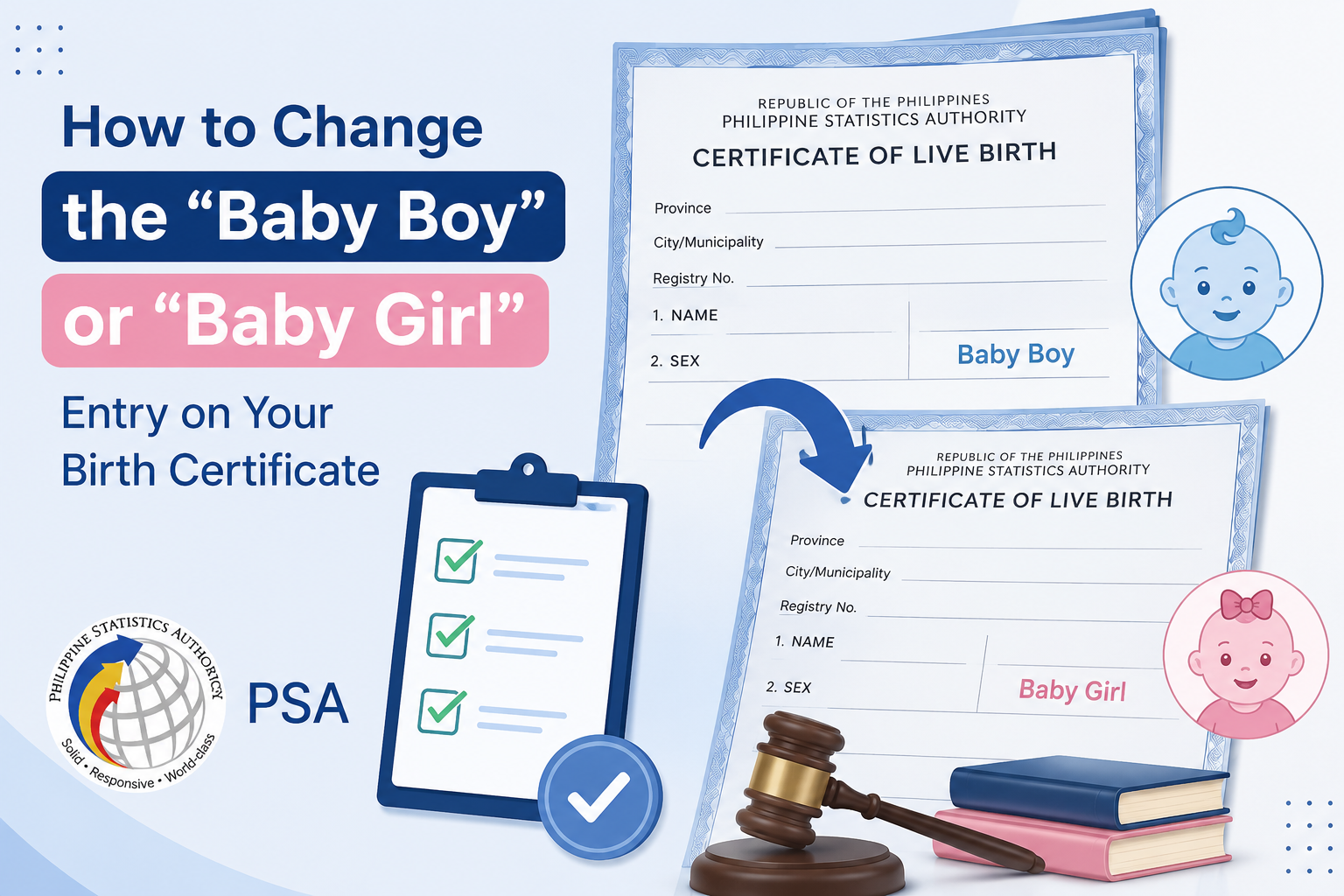
Being named “Baby Boy,” “Baby Girl,” “Boy,” or “Girl” might sound harmless when you’re an infant. But carrying that name into adulthood — onto job applications, bank accounts, passports, and marriage licenses — is a different story entirely.
How to Change the “Baby Boy” or “Baby Girl” Entry on Your Birth Certificate 2026 is a common question for parents and individuals whose birth records still show “Baby Boy” or “Baby Girl” instead of their legal first name. This usually happens when a birth was registered before the child’s name was finalized. In 2026, correcting this information is easier if you follow the proper legal process and submit the required documents to the appropriate civil registry or government authority.
This guide explains who can request the correction, the documents you’ll need, application fees, processing times, and practical tips to help you update your birth certificate successfully.
Quick Answer Box
To change a “Baby Boy” or “Baby Girl” entry on a Philippine birth certificate, the process depends on when you were born:
- Born before 1993: File a Supplemental Report at your Local Civil Registry Office (LCRO), since the name is legally treated as “not registered.”
- Born in 1993 or later: File a Petition for Change of First Name under RA 9048, since the name is considered your officially registered first name.
Both routes are administrative — meaning you file with your civil registrar, not a court — which makes the process faster and cheaper than a judicial name change. Expect the process to take a few weeks to a few months, with fees ranging from free (for indigent petitioners) to around ₱3,000 locally or $150 through a Philippine Consulate abroad.
Why Babies End Up Named “Baby Boy” or “Baby Girl”
There are two common reasons this happens, and it’s worth knowing which one applies to you, since it can shape how you frame your petition.
1. Intentional naming. Some parents genuinely register “Baby” as a first name because they find it endearing. It’s more common than most people realize — one genealogy and naming database, Forebears, estimates that roughly 1 in 2,744 Filipinos is named “Baby.” A cute nickname at birth, though, doesn’t always age well into a corporate title, a diploma, or a professional license.
2. Hospital default labels that were never replaced. Hospitals commonly use “Baby Boy [Surname]” or “Baby Girl [Surname]” as a temporary nursery identifier before parents finalize a name. If the paperwork submitted to the Local Civil Registry Office (LCRO) was filed before the real name was decided — or if there was a clerical mix-up — that placeholder can end up permanently printed on the PSA Certificate of Live Birth.
Either way, the fix is the same type of legal process, though the specific route depends on your birth year.
The Legal Basis: Two Different Rules Depending on Birth Year
The Philippine Statistics Authority (PSA) and the Office of the Civil Registrar General treat this issue differently depending on when the birth was registered. This distinction comes from a Memorandum Circular dated September 12, 2008, titled “Revisions in Paragraph 2, Case No. 1 of Memorandum Circular No. 2007-2008.”
Here’s the key rule:
- Born before 1993: A first name of “Baby Boy,” “Baby Girl,” “Baby,” “Boy,” or “Girl” is treated as if no first name was ever registered at all.
- Born in 1993 or onwards: That same entry is treated as your officially registered first name — meaning a formal name change process applies, not a simple correction of an omission.
This distinction matters because it determines which legal remedy applies to your case: a supplemental report (for missing information) or a petition for change of first name under Republic Act No. 9048 (for correcting an already-registered name).
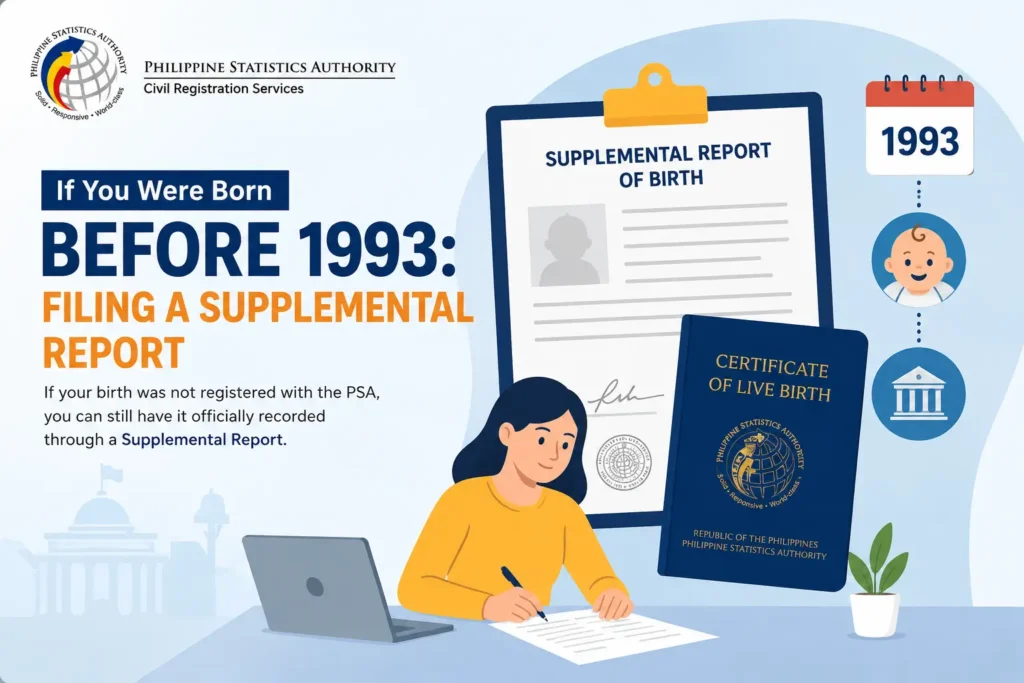
If You Were Born Before 1993: Filing a Supplemental Report
A supplemental report is the document you file when a civil registry record is missing information — in this case, treating your first name as unrecorded rather than incorrectly recorded.
It can be filed by:
- The document owner (you), or
- Either parent, or
- A legal guardian
For Applicants Born in the Philippines: Step-by-Step
- Go to the LCRO of the city or municipality where your birth was originally registered.
- Submit your documents, including:
- Three photocopies of your PSA birth certificate showing the entry to be corrected
- Three photocopies of any three valid supporting IDs or documents (see the checklist below)
- Pay the filing fee at the cashier.
- Wait for review. The LCRO checks your documents for completeness and identifies any missing requirements.
- Receive the supplemental report and affidavit once your documents are approved.
- Get PSA endorsement. Bring the supplemental report to the nearest PSA provincial office for endorsement to the Office of the Civil Registrar General.
- Send the documents. Courier the supplemental report, affidavit, and endorsement letter to the Office of the Civil Registrar General via an accredited courier (JRS, LBC, or DHL). Keep your receipt.
- Verify after 3 working days. Visit the Office of the Civil Registrar General at the PSA Complex, East Avenue, Quezon City, bringing:
- The courier transaction receipt
- Your personal copy of the supplemental report
- Your old PSA birth certificate
For Applicants Born Abroad: Step-by-Step
- Go to the appropriate Philippine Consulate with jurisdiction over your place of birth.
- Submit the following:
- Three photocopies of your PSA birth certificate showing the entry to be corrected
- A photocopy of the data page of your passport
- Three photocopies of any three valid supporting documents
- Document review. The Consular Officer checks for completeness and flags anything missing.
- Pay the filing fee once documents are approved.
- Receive your supplemental report and affidavit.
- Follow the Consular Officer’s instructions for the remaining steps, since procedures can vary slightly by post.
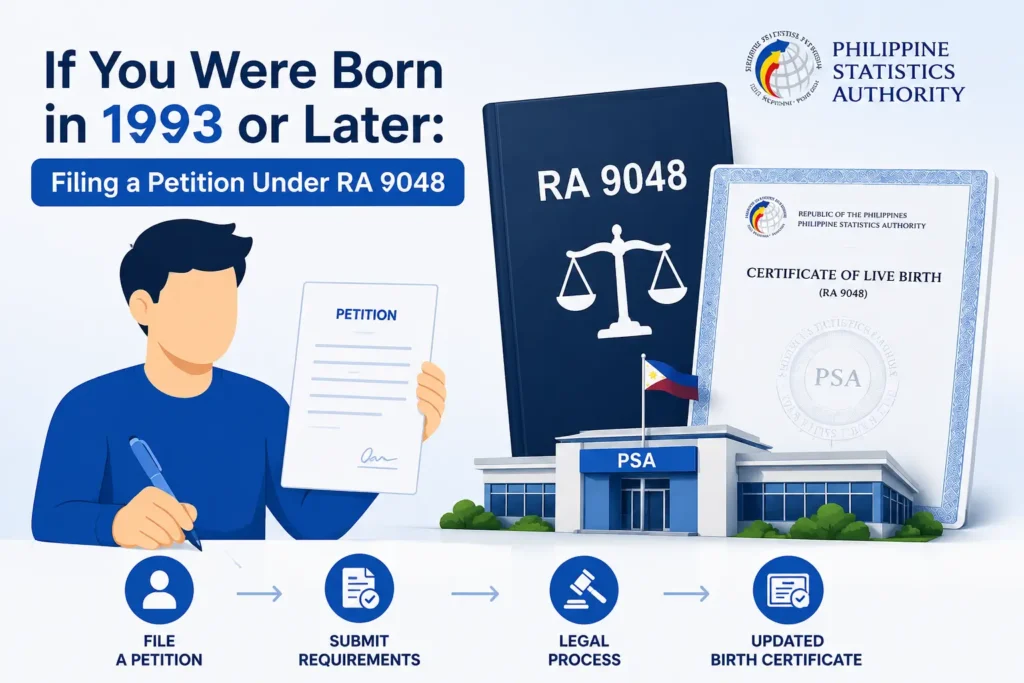
If You Were Born in 1993 or Later: Filing a Petition Under RA 9048
If your birth falls in 1993 or later, “Baby Boy” or “Baby Girl” is considered your legally registered name — so the fix is a Petition for Change of First Name under Republic Act No. 9048.
What RA 9048 Actually Does
RA 9048 amended Articles 376 and 412 of the Civil Code of the Philippines. Before this law, correcting any entry on a civil registry document — even an obvious clerical error — required a court order. RA 9048 changed that.
Under RA 9048, city or municipal civil registrars can now correct clerical or typographical errors, and process a change of first name, through an administrative petition — no trial required. This cuts what used to take months (or years) in court down to a much simpler filing process.
Important: you can only file this petition once per person. The LCRO keeps a permanent record of it, so it’s worth getting the paperwork right the first time.
Where to File
- If you live in the Philippines: File at the LCRO of the city or municipality where your birth was registered.
- If you live abroad: File at the nearest Philippine Consulate.
Step-by-Step: Filing the Petition
- Draft a notarized affidavit-petition that includes:
- The facts establishing the merit of your petition (e.g., how the name causes confusion, embarrassment, or difficulty)
- A statement establishing your competence to testify to the facts
- The exact erroneous entry and your proposed correction
- Attach your supporting documents (see checklist below).
- Prepare three copies of the petition and its attachments:
- Copy 1 → City/municipal civil registrar or consul general
- Copy 2 → Office of the Civil Registrar General
- Copy 3 → Your personal file
- Publish the petition. Per Section 5 of RA 9048, the petition must be published at least once a week for two consecutive weeks in a newspaper of general circulation.
- Pay the filing fee (unless you qualify as an indigent petitioner — see below).
- Wait for evaluation and approval from the civil registrar or consul general.
- Receive your endorsed and annotated documents, then request a corrected PSA copy once the correction is reflected in the national database.
Comparison: Supplemental Report vs. RA 9048 Petition
| Factor | Supplemental Report (Born Before 1993) | RA 9048 Petition (Born 1993 Onwards) |
|---|---|---|
| Legal basis | Memorandum Circular, Sept. 12, 2008 | Republic Act No. 9048 |
| Why it applies | Name is treated as unregistered | Name is treated as officially registered |
| Where filed | LCRO or Philippine Consulate | LCRO or Philippine Consulate |
| Newspaper publication required? | No | Yes — 2 consecutive weeks |
| Filing fee (local) | Varies by LCRO | ₱3,000 (waived for indigents) |
| Filing fee (abroad) | Consulate-set fee | $150 (waived for indigents) |
| Number of times you can file | As needed to complete the record | Only once per person |
| PSA endorsement required? | Yes | Yes, through standard annotation process |
| Typical complexity | Moderate | Slightly higher (due to publication step) |
Documents You’ll Need
Both processes require largely overlapping documents. Here’s a consolidated checklist:
Primary document:
- Three (3) photocopies of your PSA birth certificate showing the entry to be corrected
Supporting IDs (submit any three):
- Passport
- Baptismal Certificate
- Voter’s ID or Voter’s Certificate
- Driver’s License
- School ID
- School records, Transcript of Records, or Diploma
- NBI or Police Clearance
- Company ID
- Employment Record
- Medical Records
- Any other public or private document supporting the correction
If filing abroad, also bring:
- Photocopy of the data page of your passport
If filing an RA 9048 petition, also prepare:
- Notarized affidavit-petition
- At least two public or private documents proving the correct entry
- Certification of no pending case or criminal record from a law enforcement agency
- Any additional documents the civil registrar or consul general requests
How Long Does It Take?
Processing time varies by LCRO workload and whether you’re filing locally or through a consulate, but here’s a general timeline:
- Initial filing and document review: Same day to a few days
- Supplemental report processing (if applicable): A few weeks
- PSA endorsement and courier transmission: 3+ working days after courier receipt
- RA 9048 publication requirement: A mandatory 2-week minimum, since publication must run for two consecutive weeks
- Final annotation on your PSA record: Several weeks to a few months, depending on backlog
Expert tip: File early and double-check your supporting documents before submission. Incomplete document sets are the single biggest cause of delays at the LCRO level.
How Much Does It Cost?
| Filing Location | Estimated Fee | Notes |
|---|---|---|
| LCRO (Philippines) | Around ₱3,000 | May vary slightly by municipality |
| Philippine Consulate (abroad) | Around $150 | Set per RA 9048 guidelines |
| Indigent petitioners | Free | Exemption available upon proof of indigency |
Additional costs to factor in:
- Newspaper publication fees (for RA 9048 petitions)
- Notarization fees for your affidavit-petition
- Courier fees if transmitting documents to the Office of the Civil Registrar General
- Fees for requesting new copies of your corrected PSA birth certificate afterward
Common Mistakes That Delay Approval
Based on common filing errors reported by civil registrars, here’s what most often holds up an application:
- Submitting fewer than three valid supporting IDs. The requirement is strict — three separate qualifying documents, not one ID shown three times.
- Skipping the newspaper publication step for RA 9048 petitions, or publishing for less than two consecutive weeks.
- Filing at the wrong LCRO. You must file where your birth was originally registered, not necessarily where you currently live.
- Incomplete affidavit content. Missing the required elements (facts, competence to testify, exact correction sought) can get a petition bounced back.
- Losing the courier transaction receipt, which is required when verifying your supplemental report status at the Office of the Civil Registrar General.
After Approval: Getting Your Corrected PSA Birth Certificate
Once your supplemental report or RA 9048 petition is approved and annotated, you’ll need a fresh copy of your PSA birth certificate reflecting the correction. You have two main options:
- In person: Visit the nearest PSA Civil Registry System Outlet.
- Online: Request your PSA birth certificate through an authorized online portal for a more convenient, hassle-free process.
Always request a certified copy with the annotation clearly showing the correction — this is what banks, schools, employers, and government agencies will recognize as your updated legal name.
FAQs About How to Change the “Baby Boy” or “Baby Girl” Entry on Your Birth Certificate
1. Can I change my name from “Baby Boy” or “Baby Girl” without going to court?
Yes. Both the supplemental report process and the RA 9048 petition are administrative processes handled directly by your civil registrar or Philippine Consulate — no court appearance needed.
2. What’s the difference between a supplemental report and a petition for change of first name?
A supplemental report supplies missing information (used for those born before 1993, whose “Baby Boy/Girl” entry is treated as unregistered). A petition for change of first name under RA 9048 corrects an already registered name (used for those born in 1993 or later).
3. How many times can I file a petition for change of first name?
Only once. The law and the LCRO record-keeping system allow just a single petition per person, so it’s important to prepare complete, accurate documentation the first time.
4. Do I need a lawyer to file this petition?
No. Since this is an administrative — not judicial — process, you don’t need legal representation to file. However, some petitioners choose to consult a lawyer or a document-processing service for complex cases.
5. What if I was born abroad to Filipino parents?
You can file at the Philippine Consulate with jurisdiction over your place of birth, following largely the same document requirements as those filing within the Philippines.
6. Is the filing fee the same everywhere?
Generally, yes — around ₱3,000 locally or $150 abroad — though individual LCROs may have minor variations. Indigent petitioners can request a fee waiver.
7. Why does newspaper publication matter for RA 9048 petitions?
Publication gives public notice of the requested change, allowing any objections to be raised before the correction is finalized. It’s a legal safeguard built into Section 5 of RA 9048.
8. How long before I get my corrected PSA birth certificate?
After approval and annotation, you can typically request a corrected copy within a few weeks, though total processing time (filing to annotation) can take a few weeks to a few months.
9. What documents prove the “correct” first name I want to use?
You’ll need at least two public or private documents — such as a baptismal certificate, school records, or a passport — that show the name you’re petitioning to use.
10. Can my parents file this on my behalf if I’m an adult now?
Typically, the document owner files their own petition once they’re of legal age. For minors, a parent or legal guardian can file on the child’s behalf.
Conclusion
Being legally stuck with “Baby Boy,” “Baby Girl,” “Boy,” or “Girl” as a first name doesn’t have to be permanent. Philippine law gives you two clear, administrative paths depending on your birth year:
- Born before 1993? File a supplemental report at your LCRO or Philippine Consulate.
- Born in 1993 or later? File a petition for change of first name under RA 9048.
Key takeaways:
- Both processes are administrative, not judicial — faster and cheaper than going to court.
- Gather your documents carefully: three photocopies of your PSA birth certificate and three valid supporting IDs are the baseline requirement.
- RA 9048 petitions require newspaper publication and can only be filed once, so accuracy matters.
- After approval, request your corrected PSA birth certificate in person or online to make the new name official everywhere.
You outgrew the nickname years ago. Now your legal documents can finally catch up.