What Does “Manual Verification” Mean? A Complete Guide for PSA Certificate Applicants
If you’ve ordered a PSA birth certificate, marriage certificate, or CENOMAR and your tracking status suddenly shows “Manual Verification,” you’re probably wondering what that means and why your document is taking longer than expected.
Here’s the short version: manual verification means your requested civil registry document doesn’t have a digitized copy on file yet. Instead of pulling a digital record and printing it, the Philippine Statistics Authority (PSA) has to physically locate the original document in its archives, verify it, and reproduce a certified copy by hand. This naturally takes longer than a standard digital retrieval.
In this guide, we’ll break down exactly what manual verification involves, why it happens, how long it can take, and what you can (and can’t) do while you wait.
Quick Answer Box
What does “Manual Verification” mean?
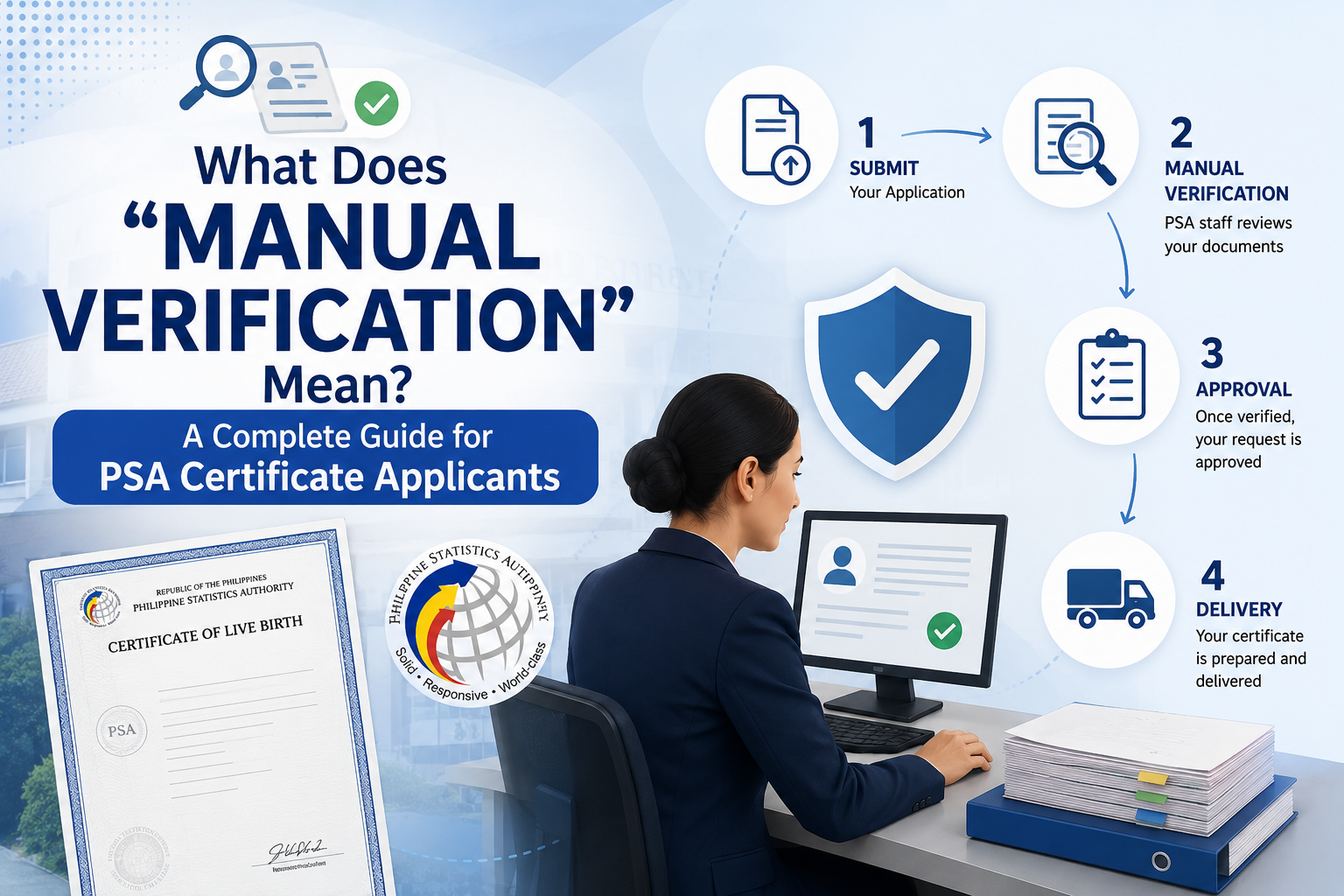
Manual verification is a status applied to a PSA document request when the certificate being requested has no existing digital copy in the PSA database. Because there’s nothing to retrieve electronically, PSA staff must:
- Search physical archives for the original record
- Confirm the document’s authenticity and details
- Manually reproduce a certified copy on PSA Security Paper (SECPA)
- Release it for delivery once verification is complete
This process has no fixed timeline, and it can extend delivery well beyond the standard 3–4 working days (Metro Manila) or up to 8 working days (provincial areas).
What Is Manual Verification?
Manual verification is a processing status used by the Philippine Statistics Authority when a requested civil registry document — a birth certificate, marriage certificate, death certificate, or Certificate of No Marriage (CENOMAR) — cannot be retrieved from PSA’s digital database.
Not every civil registry record in the Philippines has been digitized yet. The PSA has been converting decades of paper-based Local Civil Registrar (LCR) records into a searchable digital archive for years, but the process is ongoing. Older records, records from remote municipalities, or documents with incomplete prior submissions are more likely to still exist only in physical form.
When this happens, your order isn’t rejected or lost. It simply moves into a different, slower workflow: human staff have to go find the physical record themselves.
Key Facts About Manual Verification
- It does not mean your document doesn’t exist.
- It does not mean your application was denied.
- It does mean PSA needs additional time to locate and verify the physical record.
- It applies equally whether you ordered online or applied in person at a PSA office.
Why Does Manual Verification Take Longer?
Think of PSA’s digital database as a library with a fully indexed catalog — you search a title, and the system tells you exactly which shelf to pull it from. Manual verification is what happens when a book isn’t in that catalog yet. Staff have to go through storage room by room, box by box, until they find it.
Here’s what makes the process slower:
- No searchable index — Without a digital record, staff can’t run a simple database query.
- Physical archive search — Records may be stored across different facilities depending on where and when the event (birth, marriage, death) was registered.
- Manual verification of details — Once found, the document must be checked against the request details (full name, date, place of registration) to confirm it’s the correct match.
- Manual reproduction — The certified copy then has to be prepared and printed on PSA Security Paper (SECPA), the same tamper-proof paper used for all official PSA-issued certificates.
Each of these steps depends on staff availability and archive volume, which is why there’s no standard turnaround time for manual verification cases.
How Will I Know If My Order Needs Manual Verification?
If you ordered through an accredited online channel such as PSAHelpline.ph, you’ll typically receive automatic updates at each stage of processing via SMS and email, including when your order is:
- Being processed by PSA
- Released by PSA
- Dispatched to the courier
- Out for delivery
You can also check your order status directly on the platform using your order reference number.
If your status shows “Manual Verification,” that’s your signal that:
- Your document has no digital copy on file
- PSA is actively searching its physical archives for it
- Your delivery timeline will likely extend past the usual 3–8 working days
Manual Verification vs. Standard Digital Retrieval
Here’s a side-by-side comparison to make the difference clear:
| Factor | Standard Digital Retrieval | Manual Verification |
|---|---|---|
| Record format | Already digitized | Physical/paper only |
| Retrieval method | Database search | Manual archive search |
| Typical timeline (Metro Manila) | 3–4 working days | No fixed timeline; often longer |
| Typical timeline (Provincial) | Up to 8 working days | No fixed timeline; often longer |
| Staff involvement | Minimal (automated print) | High (manual search, verification, reproduction) |
| Document validity | Fully valid PSA certificate | Fully valid PSA certificate once released |
| Applies to online orders | Yes | Yes |
| Applies to over-the-counter requests | Yes | Yes |
The key takeaway from this table: the document’s validity is identical either way. Manual verification only affects speed, not authenticity.
What Happens During Manual Verification
If your order status changes to manual verification, here’s the general process happening behind the scenes:
Step-by-Step:
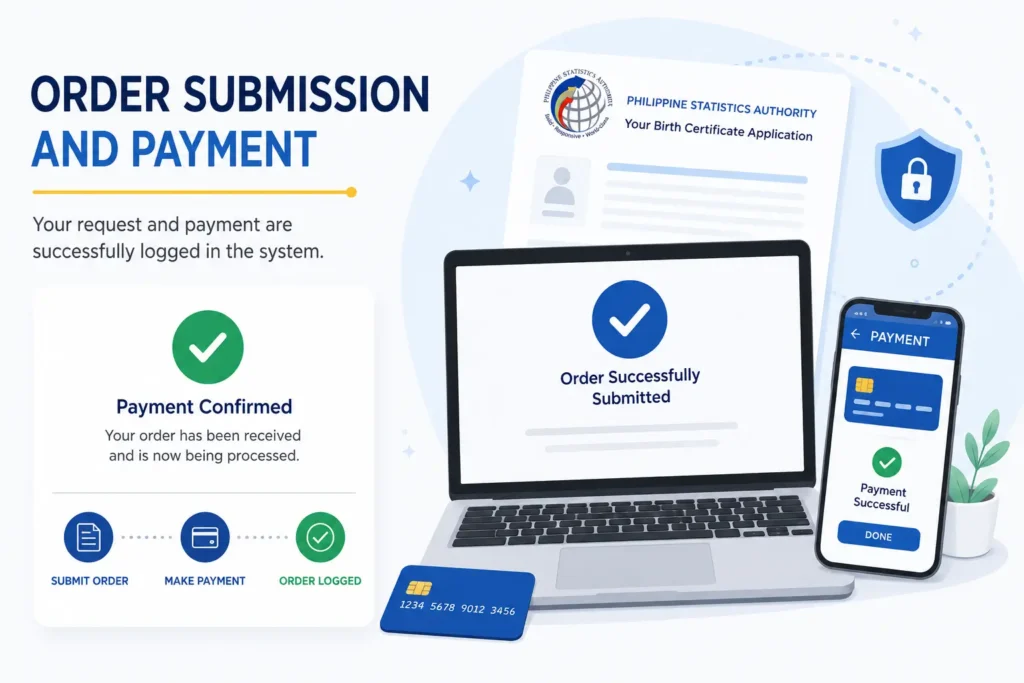
Step 1: Order Submission and Payment
Your request and payment are logged in the system. Retrieval cannot begin without this — even for over-the-counter applications, payment must be made first.
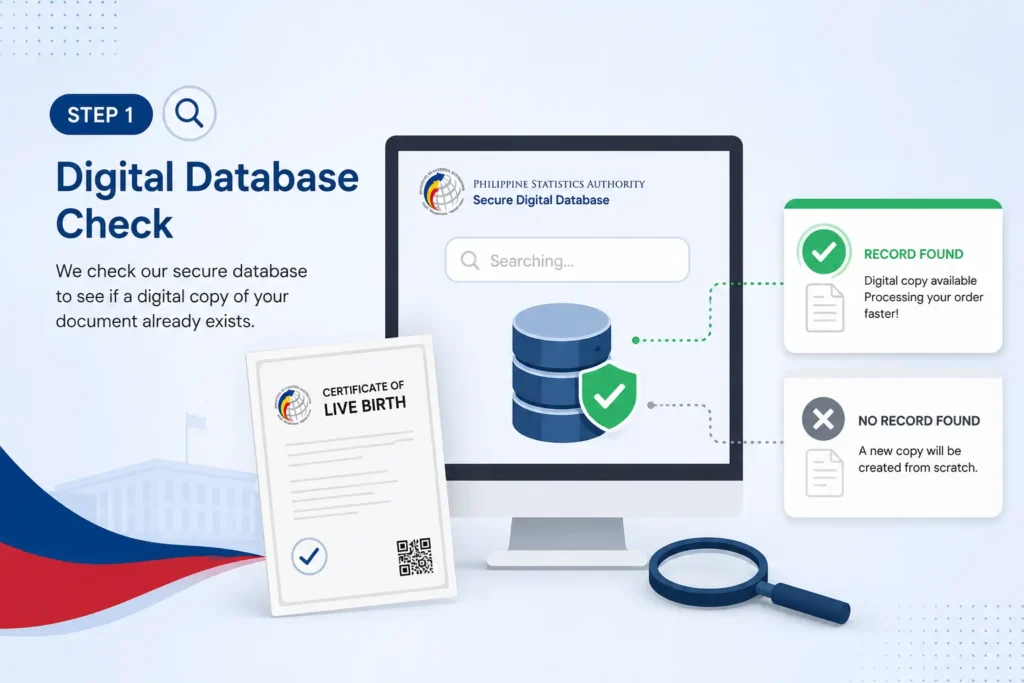
Step 2: Digital Database Check
PSA first checks whether a digital copy already exists. If it does, your order proceeds through the standard fast-track process.
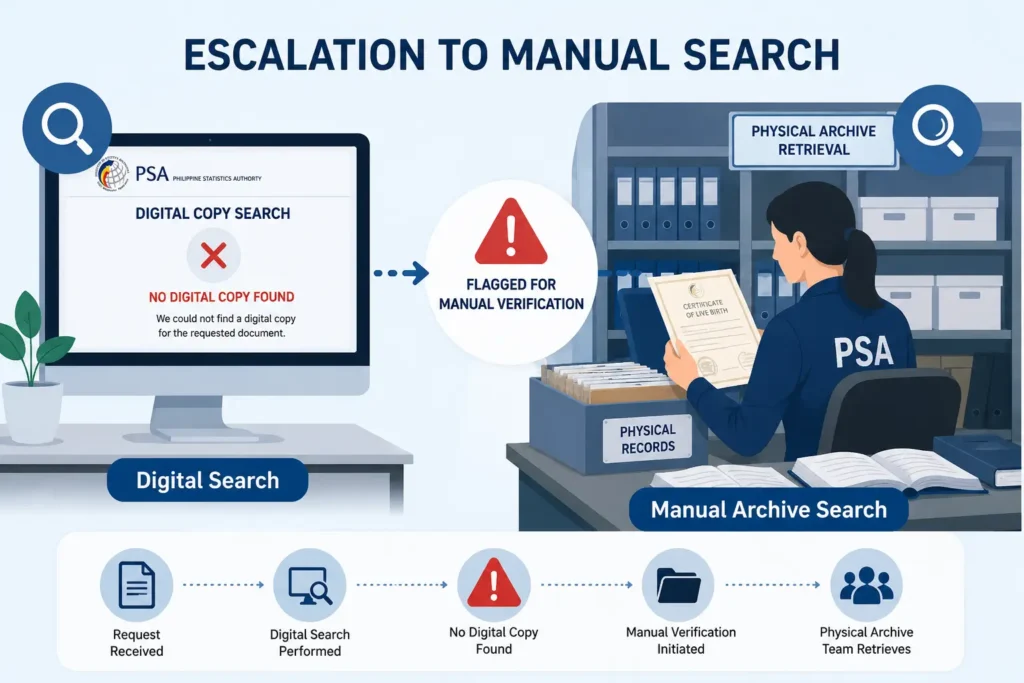
Step 3: Escalation to Manual Search
If no digital copy is found, your request is flagged for manual verification and routed to the team responsible for physical archive retrieval.
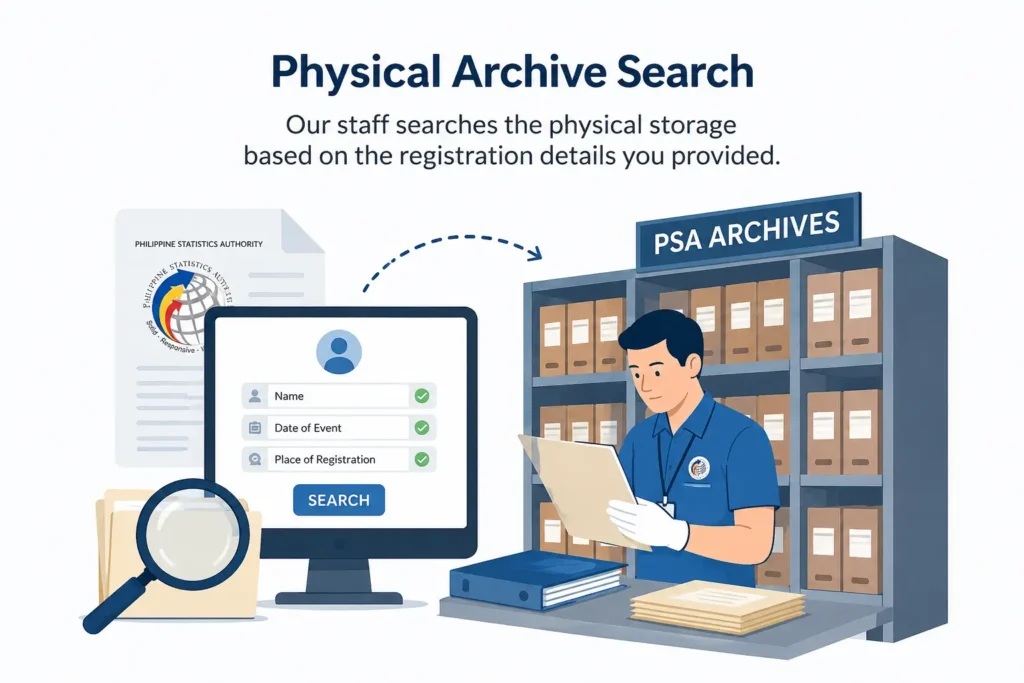
Step 4: Physical Archive Search
Staff search storage records based on the registration details you provided (name, date of event, place of registration).
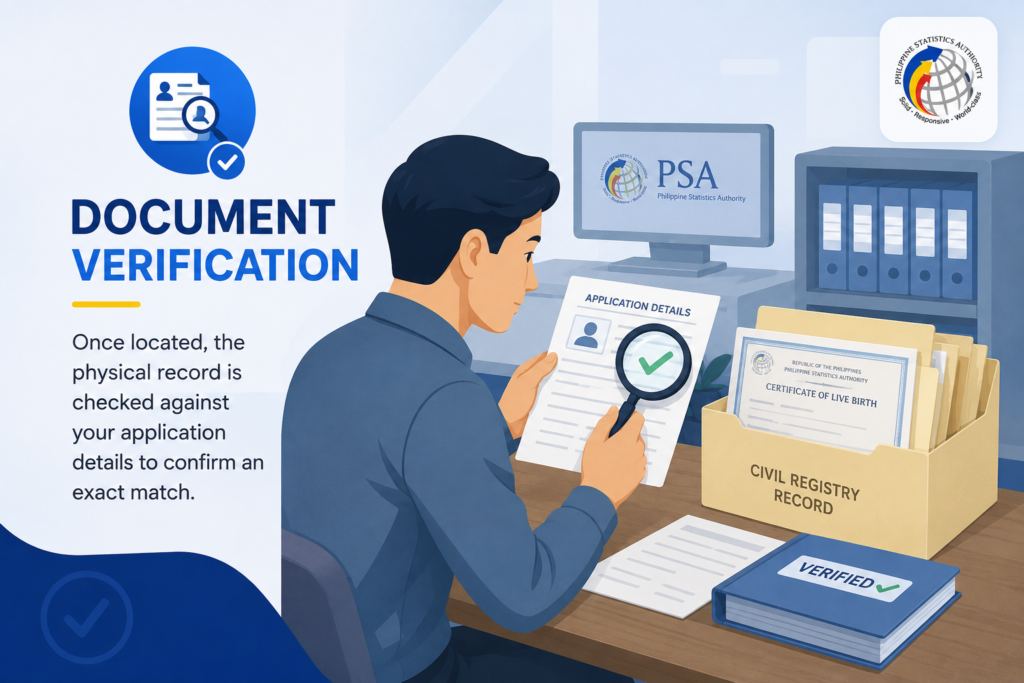
Step 5: Document Verification
Once located, the physical record is checked against your application details to confirm an exact match.
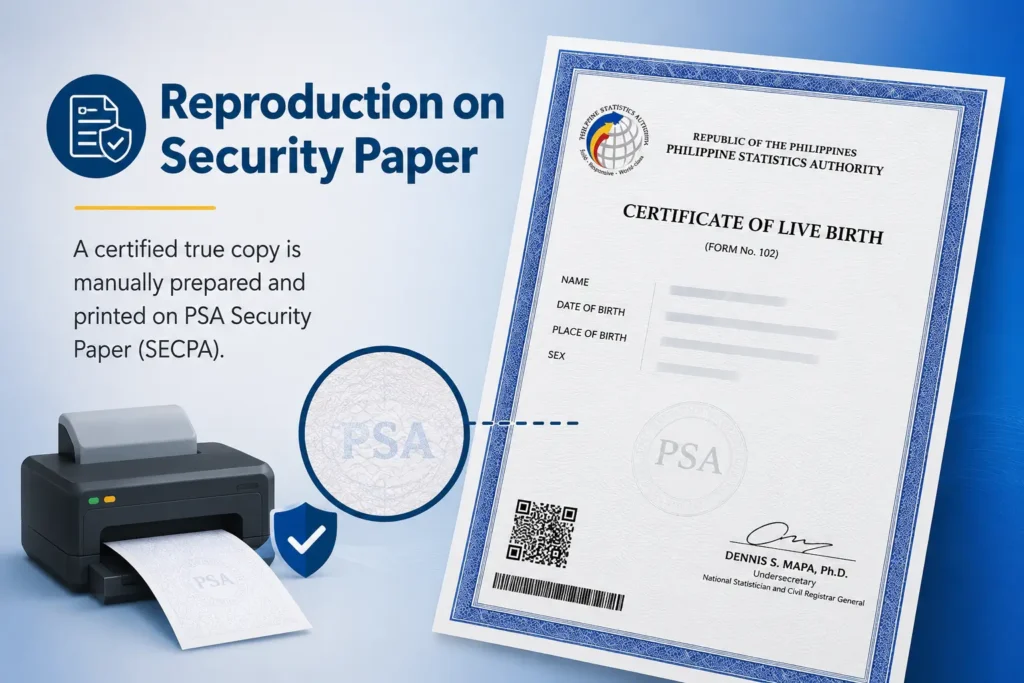
Step 6: Reproduction on Security Paper
A certified true copy is manually prepared and printed on PSA Security Paper (SECPA).
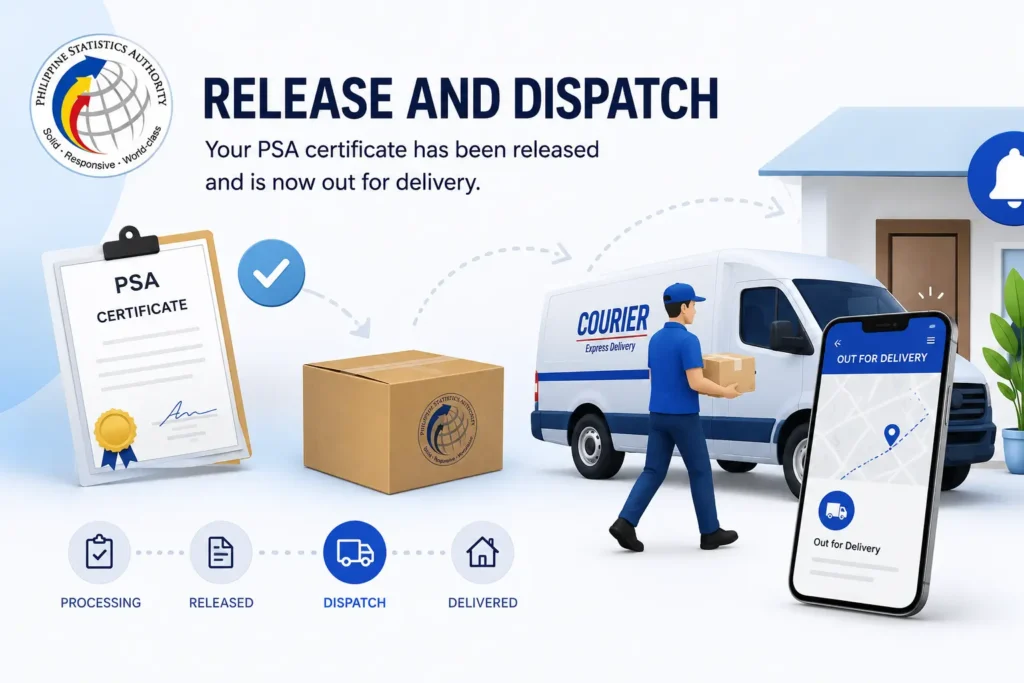
Step 7: Release and Dispatch
The completed certificate is released by PSA and handed to the courier for delivery, triggering your “out for delivery” notification.
Is There a Definite Timeline for Manual Verification?
No. There is no guaranteed or standard timeline for manual verification cases.
Because it depends on:
- The volume of archive requests being processed at that time
- The condition and location of the physical record
- Staff availability
- Whether the record needs to be sourced from a regional archive
…there’s genuinely no way to predict an exact completion date. The only reliable signal is the SMS and email notification sent once PSA releases the document for delivery.
Expert tip: If your document is time-sensitive (for example, needed for a visa application, marriage requirements, or school enrollment), apply as early as possible. Manual verification delays are one of the most common reasons applicants miss deadlines when they wait until the last minute.
Can I Request a Refund If My Order Is Delayed?
Generally, no — and here’s the reasoning behind that policy.
PSA only initiates retrieval of a certificate — digital or physical — once a paid order is submitted, whether that’s done online or over the counter. The payment is what triggers the search itself, not a guarantee of a specific delivery window.
A delay caused by manual verification doesn’t mean:
- The service failed
- The document is unavailable
- The order was processed incorrectly
It simply means PSA needs more time to locate and reproduce a document that isn’t yet part of its digital archive. Since the service (retrieval and issuance) is still being carried out, refunds aren’t typically issued solely due to a manual verification delay.
Will Requesting Over the Counter Be Faster?
No. This is a common misconception.
Whether you apply online through an accredited channel or walk into a PSA branch and request in person, the retrieval happens from the exact same archive — digital or physical. If your document isn’t digitized, an over-the-counter request will go through the same manual verification process and face the same uncertain timeline.
In fact, applying online through a platform like PSAHelpline.ph can be more convenient because you receive automated status updates without needing to follow up in person or call a hotline.
What to Do While Your Document Is Under Manual Verification
While you wait, here are a few practical steps that can help:
- Check your order status regularly using your reference number rather than assuming no news is bad news.
- Confirm your registration details are accurate (full name spelling, date of birth/event, place of registration) — mismatches can slow down manual archive searches further.
- Contact the Local Civil Registrar (LCR) where the event was originally registered. In some cases, the LCR can issue a copy of the certificate that can be endorsed to PSA, which may serve as an alternative while you wait.
- Plan around delays if your document is needed for a deadline-driven purpose like travel, marriage, or employment documentation.
- Avoid submitting duplicate orders, which can cause confusion in tracking and does not speed up the manual search process.
FAQs About What Does “Manual Verification” Mean?
1. What does it mean when my PSA order says “Manual Verification”?
It means your requested certificate doesn’t have a digital copy in PSA’s database, so staff must locate the physical record in the archives before it can be reproduced and released.
2. Does Manual Verification mean my document doesn’t exist?
No. It simply means the document exists only in physical form and needs to be manually retrieved, not that the record is missing or invalid.
3. How long does Manual Verification usually take?
There is no fixed timeline. It can take significantly longer than the standard 3–4 working days (Metro Manila) or up to 8 working days (provincial), depending on archive volume and record location.
4. Can I speed up Manual Verification?
Not directly, but ensuring your application details are accurate and complete can help avoid additional delays during the verification stage.
5. Will I get notified when my document is released?
Yes. Applicants who order through platforms like PSAHelpline.ph receive SMS and email notifications when the document is released by PSA and dispatched for delivery.
6. Is a manually verified certificate less valid than a digitally retrieved one?
No. Once issued, both types of certificates carry the same legal validity and are printed on the same PSA Security Paper (SECPA).
7. Can I get a refund if my document takes too long due to Manual Verification?
Typically no, since payment triggers the retrieval process itself, not a guaranteed delivery date. The service is still being fulfilled; it’s simply taking longer.
8. Is applying over the counter at a PSA office faster than online?
No. Both methods pull from the same digital or physical archive, so a document without a digital copy will undergo the same manual verification process either way.
9. What should I do if my document is urgently needed?
Apply as early as possible, double-check your submitted details for accuracy, and consider checking with your Local Civil Registrar for an alternative certified copy in the meantime.
10. Where can I check the status of my PSA order?
You can check your order status online using your order reference number through the platform you used to place your request, such as PSAHelpline.ph.
Conclusion
Manual verification isn’t a red flag — it’s simply what happens when your PSA document hasn’t been digitized yet. Instead of a quick database pull, PSA staff have to physically locate, verify, and reproduce your certificate, which naturally takes more time and has no fixed completion date.
Key takeaways:
- Manual verification means no digital copy exists yet — not that your document is invalid or unavailable.
- The process involves manual archive search, verification, and reproduction on PSA Security Paper.
- There’s no guaranteed timeline, so patience (and early applications) matter, especially for time-sensitive needs.
- Refunds are generally not applicable for delays caused by manual verification, since the retrieval process was already triggered by payment.
- Applying online or in person makes no difference in speed — both pull from the same archive.
If you’re planning to request a PSA certificate for something important, apply well ahead of your deadline, double-check your details, and keep an eye on your order status to stay informed every step of the way.