Marriage Certificate vs. Report of Marriage: Complete Guide 2026
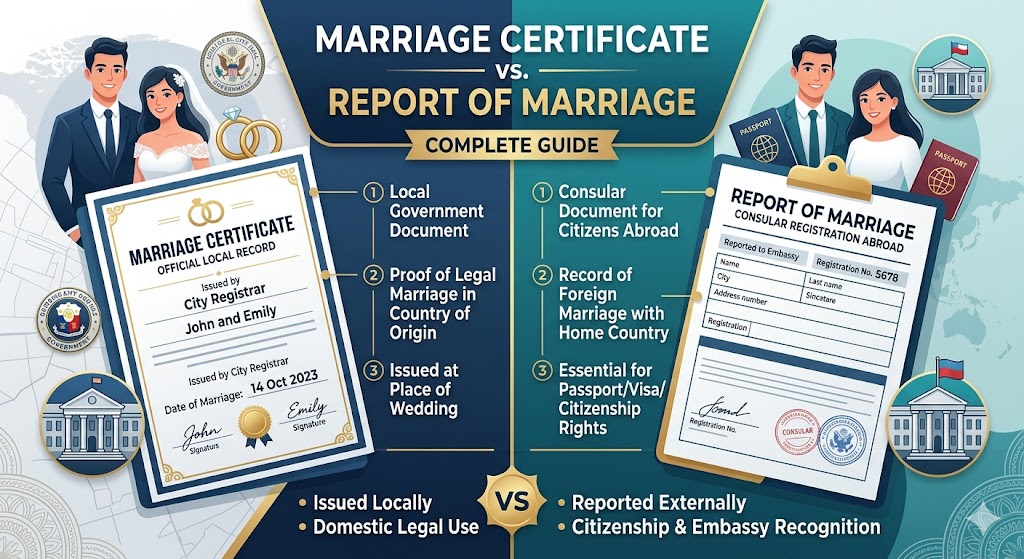
Marriage Certificate vs. Report of Marriage is an important topic for couples who need to understand legal proof of marriage for immigration, passport, and government documentation purposes. Although both documents confirm that a marriage is legally valid, they are issued by different authorities and serve different functions. A Marriage Certificate is issued by the local civil registrar where the marriage is registered, while a Report of Marriage is submitted by couples married abroad through a Philippine Embassy or Consulate. In this complete 2026 guide, we will explain the key differences, requirements, uses, and step-by-step application process so you can avoid delays in legal or official transactions.
Quick Answer
What is the difference between a Report of Marriage and a Marriage Certificate?
- A Report of Marriage is a document filed by Filipinos who got married outside the Philippines at a Philippine Embassy or Consulate. It ensures the foreign marriage is officially recognized and registered back home.
- A Marriage Certificate (also called a Marriage Contract) is a legal document issued by the Local Civil Registry Office (LCRO) in the city or municipality where the wedding took place inside the Philippines.
- Both documents are ultimately registered with the Philippine Statistics Authority (PSA), making them official for legal and civil purposes in the Philippines.
What Is a Report of Marriage?
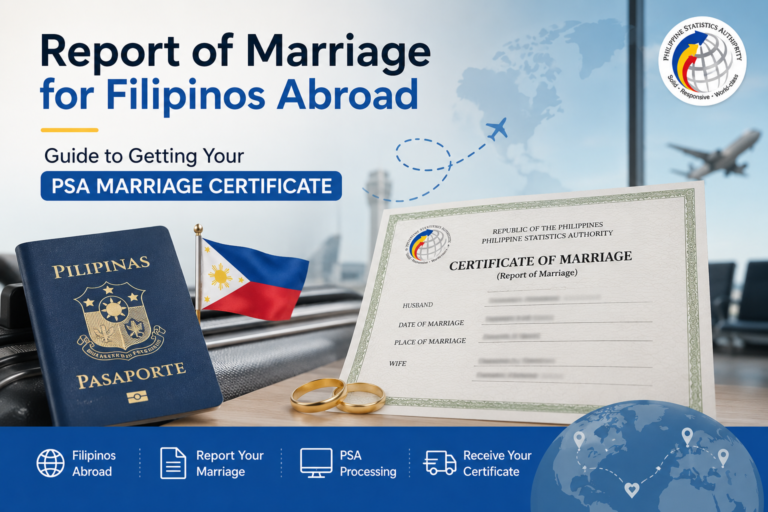
A Report of Marriage (ROM) is an official declaration submitted by a Filipino citizen who married outside the Philippines. It is filed at the Philippine Embassy or Consulate General that has jurisdiction over the location where the marriage took place.
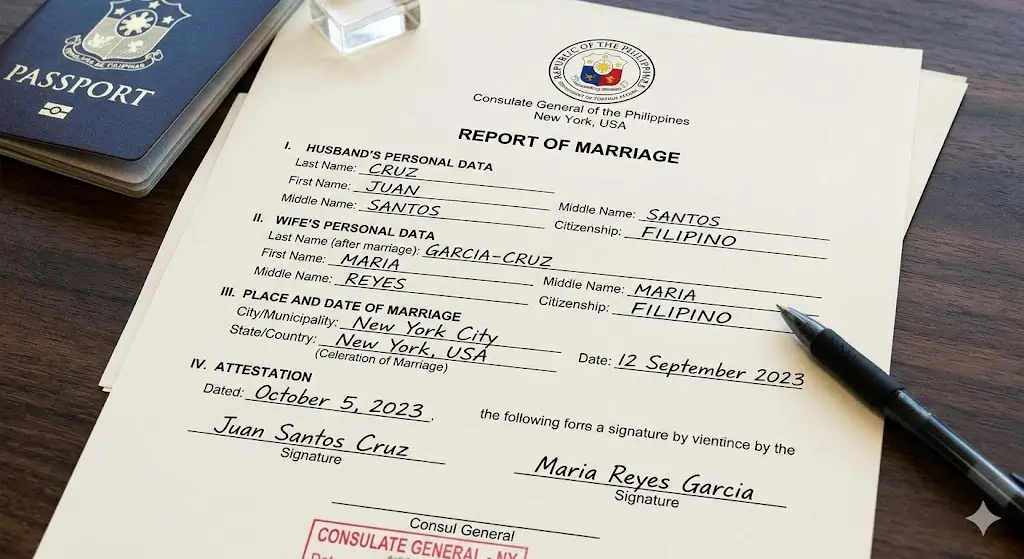
Think of it this way: when a Filipino marries abroad, the Philippine government has no automatic way of knowing about it. The Report of Marriage is the mechanism that bridges that gap. It brings the marriage into the official records of the Philippine government, so it is legally recognized under Philippine law.
Why Is the Report of Marriage Important?
- It ensures the marriage is recognized by the Philippine government.
- It allows the couple to eventually obtain a PSA-certified marriage certificate, even if the marriage occurred abroad.
- It is required for legal transactions in the Philippines such as changing your name on government IDs, updating beneficiaries, filing for spousal benefits, or processing immigration-related documents.
- Without it, the Philippine government has no official record of your foreign marriage.
Who Files the Report of Marriage?
Filing is mandatory if at least one spouse is a Filipino citizen, regardless of where the marriage occurred. Even if both spouses are Filipino nationals who happened to marry abroad, both must file the Report of Marriage at the nearest Philippine Embassy or Consulate.
Real-World Example
A Filipina nurse working in California marries a US citizen in Los Angeles. After their wedding, they are required to file a Report of Marriage at the Philippine Consulate General in Los Angeles. The Consulate then registers the marriage with the PSA, making it officially recognized in the Philippines.
What Is a Marriage Certificate?
A Marriage Certificate (officially called a Marriage Contract under Philippine law) is a legal document issued by the Local Civil Registry Office (LCRO) of the city or municipality where the marriage ceremony took place within the Philippines.

After the marriage officiant submits the signed marriage certificate to the LCRO, the civil registrar enters the marriage details into the Register of Marriages. The LCRO then endorses the certificate to the Philippine Statistics Authority (PSA), which certifies it and prints it on the PSA Security Paper (SECPA).
Why Is the Marriage Certificate Important?
- It serves as the primary proof of marriage for all legal transactions in the Philippines.
- It is required when applying for spousal visas, changing your civil status on IDs, claiming death or retirement benefits, and filing for annulment or legal separation.
- The PSA-certified copy is the most widely accepted version for both government and private institutions.
Who Issues the Marriage Certificate?
The solemnizing officer (priest, judge, mayor, or other authorized official) fills out the marriage certificate during or immediately after the ceremony. Both spouses and two witnesses sign it. The original is submitted to the LCRO, which then forwards it to the PSA.
Key Differences at a Glance
| Feature | Report of Marriage | Marriage Certificate |
|---|---|---|
| Purpose | Reports a marriage that occurred abroad to Philippine authorities | Serves as legal proof of a marriage that occurred in the Philippines |
| Where Filed | Philippine Embassy or Consulate General abroad | Local Civil Registry Office (LCRO) in the Philippines |
| Who Files It | The married couple (at least one must be Filipino) | The solemnizing officer submits it automatically |
| When Filed | After a marriage takes place outside the Philippines | Immediately after the ceremony, within the Philippines |
| Issued By | Philippine Embassy / Consulate → PSA | LCRO → PSA |
| End Document | PSA-certified Marriage Certificate | PSA-certified Marriage Certificate |
| Applicable Law | Philippine laws on civil registration | Philippine Family Code / Civil Registration Law |
| Deadline | Must be filed within 1 year; after 1 year, an Affidavit of Delayed Registration is needed | Usually processed automatically within days of the ceremony |
| Who Needs It | Filipinos who married abroad | Filipinos who married inside the Philippines |
Who Needs a Report of Marriage?
You need to file a Report of Marriage if:
- You are a Filipino citizen who got married in another country.
- Both spouses are Filipinos who got married abroad.
- You are a Filipino who married a foreign national outside the Philippines.
- Your marriage was solemnized in a foreign country by a foreign government official or religious authority.
You do not need a Report of Marriage if your wedding took place inside the Philippines. In that case, the LCRO process handles everything automatically.
Basic Requirements for Filing a Report of Marriage Abroad
The specific documentary requirements may vary depending on the country or consular district where you are filing. However, the following core documents are typically required.
Standard Requirements
1. Notarized Report of Marriage Form
- The wife must write her maiden last name as her surname on the form.
- Both the husband and wife must complete and sign four (4) copies of the Report of Marriage form.
- The form must be notarized by a local notary public (e.g., a US notary public if filing in the United States).
2. Marriage Contract or Certificate Issued by the Foreign Vital Records Office
- This is the official marriage document issued by the country or state where the marriage took place.
- It must be an authenticated or apostilled copy, depending on the country.
3. Proof of Filipino Citizenship at the Time of Marriage This may include any of the following:
- US Permanent Resident Card (Green Card)
- Valid visa or work permit showing Filipino nationality
- Dual Citizenship documents (RA 9225)
- Valid Philippine passport
4. PSA Birth Certificates of Both Spouses
- The PSA-certified birth certificate of the Filipino spouse is required.
- The foreign spouse may be asked to provide their birth certificate as well.
5. Valid Passports or Government-Issued IDs of Both Parties
6. Affidavit of Delayed Registration (only if filing more than one year after the marriage date)
Additional Requirements (Depending on Country/Consulate)
Some embassies or consulates may also require:
- Certificate of No Marriage Record (CENOMAR) or Certificate of Singleness
- Divorce decree or death certificate of former spouse (if either party was previously married)
- Apostille or authentication of foreign marriage certificate
Expert Tip: Always contact the specific Philippine Embassy or Consulate General responsible for your area before filing. Requirements and processing times can change, and it is far better to confirm than to submit an incomplete application.
How to File a Report of Marriage
- Step 1: Gather All Required Documents: Collect all the documents listed above. Make sure your marriage certificate from the foreign vital records office is apostilled (if the country is a Hague Convention member) or authenticated by the Philippine Embassy.
- Step 2: Complete the Report of Marriage Form: Download the Report of Marriage form from the official website of the Philippine Embassy or Consulate General in your area. Fill it out carefully. The wife must use her maiden name, not her married name, on this form.
- Step 3: Have the Form Notarized: Both spouses must sign all four copies of the form before a local notary public. Make sure the notarization is valid in the jurisdiction where you are filing.
- Step 4: Submit Your Application to the Philippine Embassy or Consulate: Submit your complete documentary requirements in person or by mail (if allowed by the specific consulate). Pay the applicable filing fee.
- Step 5: Wait for Processing: Processing times vary by embassy or consulate. Some process applications within a few weeks; others may take longer, especially during peak periods.
- Step 6: The Embassy Transmits Your Records to the PSA: Once approved, the Philippine Embassy or Consulate General transmits your marriage details to the Philippine Statistics Authority (PSA) for official registration.
- Step 7: Request Your PSA-Certified Marriage Certificate: After a reasonable processing period (typically several months after transmittal), you may now request a PSA-certified copy of your marriage certificate through PSA outlets or online.
How to Obtain a PSA Marriage Certificate in the Philippines
For couples who married inside the Philippines, the process is more straightforward.
- The solemnizing officer prepares and signs the Marriage Certificate during or right after the ceremony.
- Both spouses and two witnesses sign the document.
- The marriage officiant submits the certificate to the LCRO within the prescribed timeframe.
- The LCRO registers the marriage and forwards the record to the PSA.
- After the processing period (usually a few months), the couple may request a PSA-certified copy.
How to Request a PSA-Certified Copy of Your Marriage Certificate
Whether your marriage was registered through an LCRO (local ceremony) or through a Philippine Embassy (Report of Marriage), you can obtain a PSA-certified copy in two ways:
Option 1: Walk-In at a PSA CRS Outlet
- Visit the nearest PSA Civil Registration System (CRS) outlet.
- Bring a valid government-issued ID.
- Fill out the request form and pay the applicable fee.
- Receive your copy on the same day or within a few business days, depending on the outlet.
Option 2: Online Request (Delivery to Your Home)
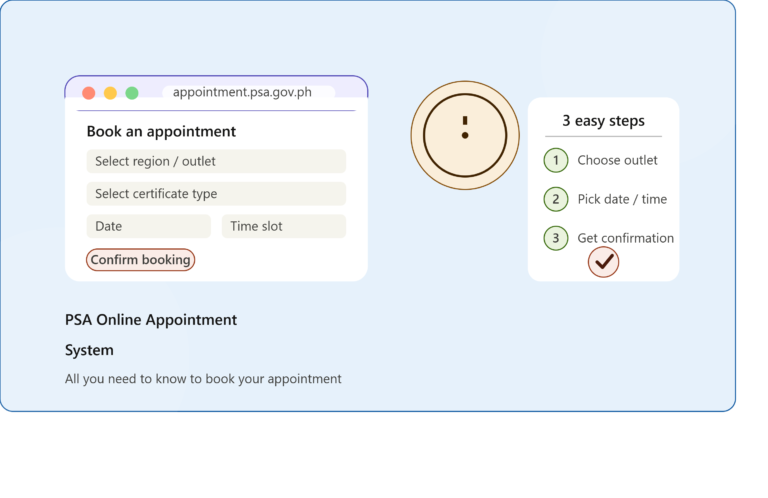
- Go to the official PSA Serbilis website (serbilis.psa.gov.ph) or the PSA Helpline website.
- Fill in your personal details and marriage information.
- Pay the fee online.
- Your PSA-certified marriage certificate will be delivered to your address.
Note: Online ordering is especially convenient for Filipinos abroad who need their PSA documents. Some online facilitators also offer international delivery.
Common Mistakes to Avoid
1. Filing the Report of Marriage Late Without an Affidavit
If you file your Report of Marriage more than one year after the marriage date, you must also submit an Affidavit of Delayed Registration. Failing to include this will result in rejection.
2. Using the Married Name on the Report of Marriage Form
The wife must always use her maiden (birth) last name on the form not her husband’s surname. This is a frequent error that causes processing delays.
3. Submitting Non-Apostilled or Non-Authenticated Documents
The foreign marriage certificate must be properly apostilled (for Hague Convention countries) or authenticated before the Embassy will accept it.
4. Not Contacting the Specific Consulate First
Requirements vary by country. What is accepted in Japan may differ from what is required in the UAE. Always verify requirements with your specific consulate before applying.
5. Confusing a Local Marriage Certificate with a PSA Marriage Certificate
A local marriage certificate from the LCRO is not the same as a PSA-certified marriage certificate. Most government agencies and foreign embassies require the PSA-certified version printed on PSA Security Paper (SECPA).
FAQs About Marriage Certificate vs. Report of Marriage
1. Can I use a local marriage certificate from the US instead of a PSA certificate for Philippine transactions?
No. For Philippine government transactions, immigration processes, or legal proceedings in the Philippines, you need a PSA-certified marriage certificate. A foreign-issued certificate is typically not accepted on its own. You must first file a Report of Marriage so the PSA can issue its own certified copy.
2. How long does it take for the PSA to process a marriage registered through a Report of Marriage?
Processing timelines vary, but it generally takes several months after the Embassy transmits your records to the PSA. It is advisable to request your PSA certificate at least 4–6 months after your Report of Marriage was approved by the Embassy.
3. Is a Report of Marriage required if both spouses are foreigners but one has Filipino heritage?
What matters is citizenship, not heritage. If one or both spouses hold Filipino citizenship at the time of the marriage (including dual citizens under RA 9225), they are required to file a Report of Marriage.
4. What happens if I never filed a Report of Marriage for my marriage abroad?
Your foreign marriage will not be recognized in the Philippine government’s official records. This can create problems when updating civil status on Philippine IDs, applying for spousal benefits, processing immigration papers, or conducting any legal transaction that requires proof of marriage in the Philippines.
5. Can I file a Report of Marriage years after the wedding?
Yes, but you will need to submit an Affidavit of Delayed Registration if you are filing more than one year after the marriage date. There is no absolute deadline, but delayed filing can complicate certain legal processes.
6. Do I need a Report of Marriage if I am a Filipino who married a foreigner inside the Philippines?
No. If your marriage took place inside the Philippines, the LCRO process applies regardless of the nationality of your spouse. A Report of Marriage is only for marriages that occurred outside the Philippines.
7. How is a PSA Marriage Certificate different from an NSO Marriage Certificate?
They are the same document. The National Statistics Office (NSO) was reorganized into the Philippine Statistics Authority (PSA) in 2013. Documents previously issued by the NSO are still valid, but new requests will come from the PSA, printed on PSA Security Paper.
8. Can I request a PSA marriage certificate if I am currently living abroad?
Yes. You can order online through official PSA online portals, and some services offer international delivery. You may also authorize a representative in the Philippines to request the document on your behalf.
9. What is the PSA Security Paper (SECPA)?
PSA Security Paper (SECPA) is the official security-printed paper used by the Philippine Statistics Authority to certify civil registry documents, including birth, marriage, and death certificates. Documents printed on SECPA are the only versions accepted for most official transactions.
10. Is a church marriage certificate the same as a civil marriage certificate?
No. A church or religious marriage certificate is a record kept by the religious institution. For it to have legal standing, the marriage must also be registered with the LCRO. The solemnizing officer is required by law to submit the marriage certificate to the LCRO after the ceremony.
Conclusion
Understanding the difference between a Report of Marriage and a Marriage Certificate is not just a bureaucratic formality — it has real legal consequences for Filipino citizens, especially those in cross-border marriages or living abroad.
Here are the key takeaways from this guide:
- A Report of Marriage is for Filipinos who married outside the Philippines. It must be filed at the Philippine Embassy or Consulate with jurisdiction over where the marriage took place.
- A Marriage Certificate is for marriages that occurred inside the Philippines, processed through the Local Civil Registry Office and endorsed to the PSA.
- Both ultimately result in a PSA-certified marriage certificate, which is the gold standard for legal and government transactions in the Philippines.
- Filing the Report of Marriage is mandatory for all Filipino citizens who marry abroad, regardless of the nationality of the other spouse.
- Always verify requirements with your specific Philippine Embassy or Consulate before filing, as documentary requirements can vary by country.
- If you have not yet filed a Report of Marriage for your foreign marriage, it is never too late — but be prepared to submit an Affidavit of Delayed Registration if more than one year has passed.
Taking these steps ensures your marriage is fully recognized under Philippine law, protecting your rights and your spouse’s rights in all legal matters going forward.