PSA vs. Local Civil Registry Birth Certificate 2026
Dealing with birth certificate requirements in the Philippines can be confusing, especially when different offices ask for different versions. Knowing which document to use – and when – saves you from unnecessary delays and rejected applications.
This guide breaks down the key differences between a PSA and Local Civil Registry birth certificate, when you need each one, and how to get them without the hassle.
What is the Difference Between a PSA vs. Local Civil Registry Birth Certificate?
Most people don’t realize these two documents come from completely different levels of government – and that difference matters a lot in practice.
When a child is born, the birth is registered at the city or municipal hall where it happened. That office is the Local Civil Registry Office (LCRO). It stores the original record in its local archives – think of it as the starting point of your legal identity.
The PSA birth certificate is a copy of that same local record, but printed on special security paper (SECPA) and issued by the Philippine Statistics Authority – the central repository for all civil registry documents in the Philippines. For any document to be considered authenticated and valid for national or international use, it must come from the PSA.
The government moved toward requiring PSA-issued documents because local records were easier to forge. With PSA, your identity gets verified against a national database – not just a local file somewhere in a municipal hall.
What is a PSA Birth Certificate?
A PSA birth certificate is the official, authenticated version of your birth record. It is:
- Printed on SECPA (security paper)
- Issued by the Philippine Statistics Authority
- Verified through a national database
- Accepted for legal, government, and international transactions
- Required for passport, visa, employment, and most official purposes
It is the most authoritative version of your birth record and the one most government offices and embassies will ask for.
What is a Local Civil Registry (LCR) Birth Certificate?
The LCR birth certificate is the original source record filed at the local government level. It is:
- Issued by the Local Civil Registrar of your city or municipality
- Printed on plain paper or as a certified true copy
- Mostly accepted for local verification and initial documentation
- The starting point for any corrections or amendments
- Generally processed faster than PSA – sometimes same day
It’s not built for final submission in legal or official transactions, but it plays a critical role when something needs to be fixed in your PSA record.
PSA vs. Local Civil Registry Certificate
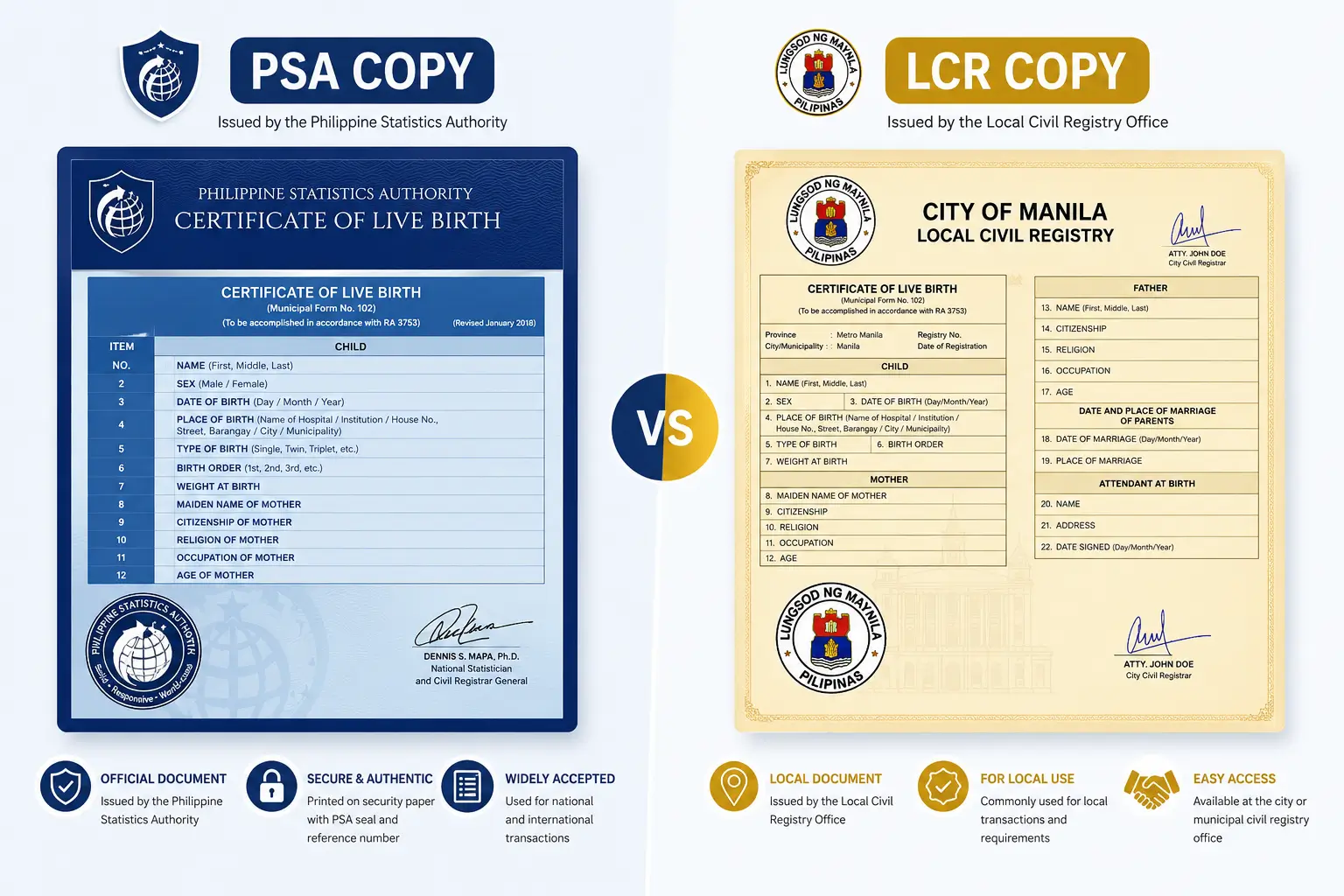
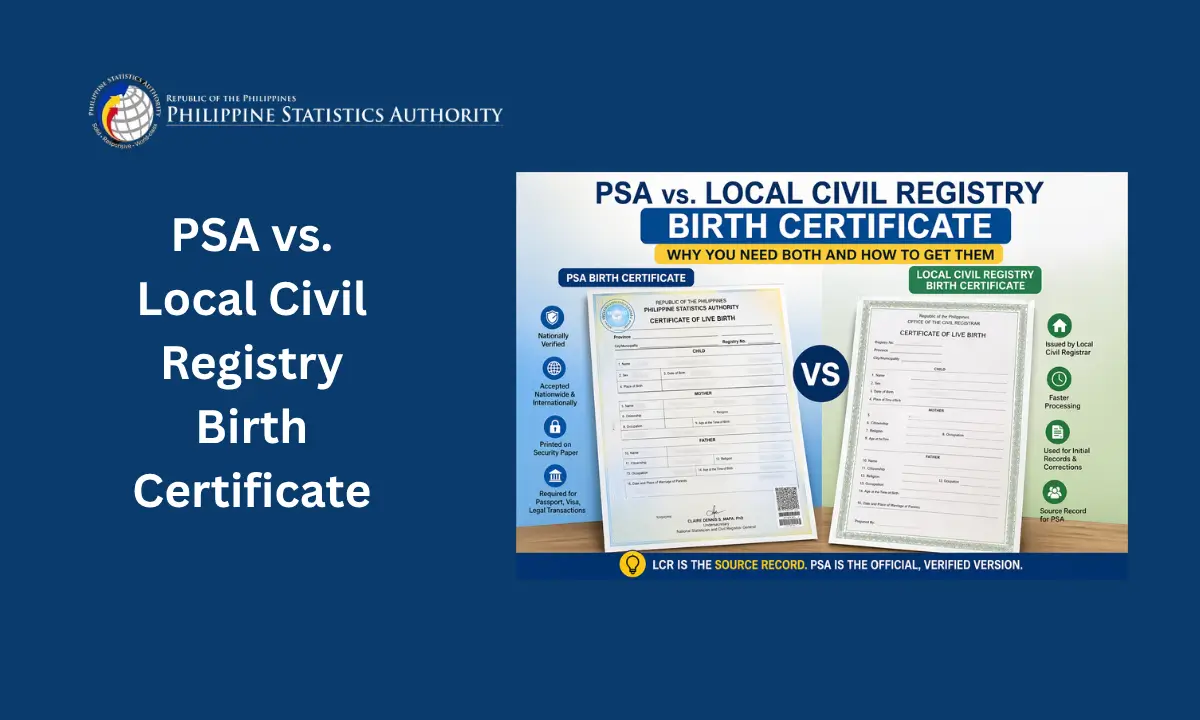
| Feature | PSA Birth Certificate | LCR Birth Certificate |
|---|---|---|
| Issued By | Philippine Statistics Authority | Local Civil Registry Office |
| Paper Type | Security Paper (SECPA) | Plain paper / Certified true copy |
| Accepted For | National & international transactions | Local verification only |
| Availability | Nationwide via PSA online or walk-in | Only at place of registration |
| Processing | Moderate (online or appointment) | Faster, often same day |
| Authenticity Level | High | Moderate |
| Main Purpose | Passport, visa, legal, employment | Initial record, corrections |
When Do You Need Each One?
Use your PSA Birth Certificate for:
- Passport applications (DFA strictly requires this)
- Visa applications for tourism or work abroad
- Marriage license and CENOMAR processing
- Government transactions – SSS, PhilHealth, Pag-IBIG, TIN
- Employment onboarding and HR verification
- College enrollment, graduation clearance, and board exams
- Embassy submissions for any legal purpose
Use your LCR Birth Certificate for:
- Correcting errors – misspelled names, wrong birth dates, missing middle initials
- When your PSA record is not yet available
- Genealogy research and tracing family history
- Personal records and community-level documentation
- Supporting document when starting a correction process at the LCRO
Quick reminder: LCR is the source record. PSA is the verified final version. You often need to understand both to move forward efficiently.
How to Get a PSA Birth Certificate
Online via PSAHelpline.ph or PSA Serbilis
- Go to the official PSA Online Portal
- Select “Birth Certificate” as your document type
- Fill out the application form – name, birthdate, parents’ names
- Pay via credit card, GCash, Maya, over-the-counter at partner banks, or convenience stores
- Wait for delivery to your doorstep within 3–9 working days
Walk-in via PSA Online Appointment
- Book your slot at the PSA Online Appointment System
- Choose your preferred PSA CRS outlet, date, and time
- Save or print the QR code from your confirmation
- Arrive 15 minutes early with a valid ID and payment
- Claim your certificate – usually same day if no record issues
How to Get an LCR Birth Certificate
- Visit the Local Civil Registry Office where your birth was registered
- Fill out the request form
- Present a valid ID
- Pay the required processing fee
- Receive your document – usually same day or within a few days
Note: LCR copies are for initial verification or correction purposes not for final legal submission.
Requirements at a Glance
| Requirement | PSA | LCR |
|---|---|---|
| Valid ID | ✔ | ✔ |
| Application Form | ✔ | ✔ |
| Appointment | ✔ | ✗ |
| Payment | ✔ | ✔ |
Common Problems and How to Fix Them
Even with a working system, problems come up – usually at the worst possible time.
1. PSA Record Not Found (Negative Result) Your LCRO has the record but it never made it to the national database. This usually happens because the local civil registry failed to properly transmit the record to PSA.
- Fix: Get your LCR certificate and request a PSA endorsement through your LCRO
2. Errors in Your Certificate Misspelled names, incorrect birth dates, and missing middle initials look minor but cause major setbacks for passport, visa, and employment applications.
- Fix: File a Petition of Correction at the LCRO first, then the update moves up to PSA
3. Unreadable or Damaged Records Older LCRO archives sometimes have faded ink, torn registry pages, or poor-quality digitization – entries the PSA cannot process or release.
- Fix: Work directly with your LCRO to retrieve and restore the record before resubmitting
4. Urgent Requirement
- Fix: Use your LCR certificate temporarily while your PSA document is being processed
Working with a professional service provider like FileDocsPhil can save significant time here — they handle record verification, discrepancy identification, correction coordination, and final PSA document processing, especially for urgent travel, employment, or legal transactions.
Practical Tips Before You Submit
- Always double-check names, dates, and spellings on both documents before submitting
- Use your PSA certificate for all legal and official transactions without exception
- Keep a copy of your LCR record – it’s your starting point for any correction
- Book PSA appointments early – slots fill quickly and delays add up fast
- For corrections, always start at the LCRO first, not PSA
FAQs About
Q1: Is the PSA birth certificate the only document accepted for a passport?
Yes. The DFA strictly requires a PSA-issued birth certificate for all passport applications. An LCR copy alone will not be accepted.
Q2: Are PSA and LCR birth certificates the same document?
No. They differ in authority, format, and purpose. PSA is authenticated and printed on SECPA security paper. LCR is the original local record printed on plain paper.
Q3: How do I know if my PSA birth certificate is authenticated?
An authenticated PSA birth certificate is printed on official SECPA security paper and carries the PSA seal. Plain paper without security features means it is not PSA-issued.
Q4: Can I get my PSA birth certificate in one day?
Yes, through a walk-in visit to a PSA CRS outlet with a confirmed online appointment. Book your slot in advance through the PSA Online Appointment System.
Q5: How long does PSA online delivery take?
Delivery takes between 3–9 working days depending on your location after payment is confirmed.
Q6: What should I do if my PSA record shows a Negative Result?
Visit your Local Civil Registry Office, secure your LCR birth certificate, and request a PSA endorsement to transmit the record to the national database.
Q7: Where do I start if there is an error in my PSA birth certificate?
Always start at the LCRO. File a Petition of Correction there with all required and supporting documents. Once corrected at the local level, the update is transmitted to PSA.
Q8: Can I use an LCR birth certificate for employment?
Most HR departments require a PSA copy for employment onboarding to verify legal identity for TIN, PhilHealth, and Pag-IBIG registration. LCR copies are generally not accepted as a final submission.
Q9: Is the LCR birth certificate useful at all?
Absolutely. It is essential for corrections, genealogy research, family history tracing, and as a supporting document when your PSA record is unavailable or being processed.
Q10: Do I need both PSA and LCR birth certificates?
In many situations, yes. PSA handles all official and legal transactions. LCR is your foundation document for corrections and initial verification. Understanding both helps you navigate any civil registry requirement efficiently.
Conclusion
The difference between a PSA and LCR birth certificate is not just technical – it has real consequences for your passport, employment, visa, and life milestones. PSA is your go-to for anything official, while LCR is where everything begins and where corrections are handled. Knowing which one to use, keeping both accessible, and acting early when problems arise will save you from the delays and frustrations that catch most people off guard. When in doubt, start with your LCR, verify your PSA record, and don’t wait until you urgently need it to find out something is wrong.